
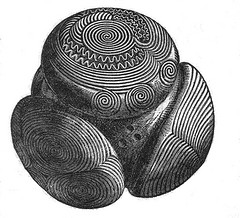
Rock and Roll

http://en.wikipedia.org/wiki/Image:Towriepetrosphere.jpg

Every so often a Scottish farmer turns up a knobbly stone ball the size of an orange. No one knows precisely who made them or why: Were they weights for fishing nets? Die-like oracles? Flung weapons? Balls used in games? Some are quite elaborately carved, and they have as many as 160 knobs.

Whatever they were, they were immensely popular among Bronze Age Scots — more than 400 have been found to date in northeastern Scotland, most in Aberdeenshire.

Costa Ricans made stone balls with somewhat larger ambitions, and Romans made enigmatic dodecahedrons. Which of our own artifacts will baffle future civilizations?

Bears Repeating

While lecturing at Oxford, geologist William Buckland kept a bear named Tiglath Pileser. (Buckland was a lunatic.) In 1847 he dressed “Tig” in a cap and gown and took him to the annual meeting of the British Association and to a garden party at the Botanic Gardens. “The bear sucked all our hands and was very caressing,” remembered Charles Lyell. Eventually banished from Christ Church, Tig retired to Islip, where he terrorized the local sweetshop owner until he was sent to the Zoological Gardens.

Byron kept a bear in his chambers at Cambridge — because, he said, Trinity rules forbade dogs. “I had a great hatred of college rules, and contempt for academical honors.” It’s said he conducted it there in a stagecoach (as “Lord Byron and Mr. Bruin”) to sit for a fellowship.

“There was, by the by, rather a witty satire founded on my bear,” Byron later remembered. “A friend of Shelley’s made an ourang-outang (Oran Hanton, Esq.) the hero of a novel (‘Melincourt’), had him created a baronet, and returned for the borough of One Vote.”