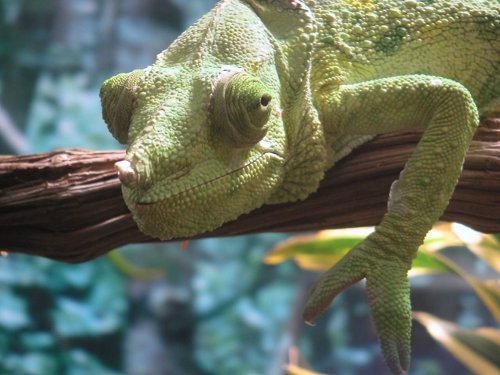
Fifty-five chameleons live on a tropical island. Thirteen are green, 19 are brown, and 23 are gray. Whenever two chameleons of different colors meet, both change to the third color. Is it possible that all 55 chameleons might eventually be the same color?
|
SelectClick for Answer |
Yes. Let x, y, and z be the number of green, brown, and gray chameleons, and consider the remainders left when each of the quantities x-y, x-z, and y-z is divided by 3. These remainders won’t change as the chameleons vary their colors. This means that if two populations are to reach 0 simultaneously, they must differ now by a multiple of 3. In this case two do: The populations of green and brown chameleons differ by 6, so it’s possible for both to disappear without any leftovers:
13, 19, 23
15, 18, 22
17, 17, 21
… and then green and brown chameleons can disappear in pairs until all have turned gray.
From Dick Hess, All-Star Mathlete Puzzles, 2009.
|