Futility Closet

The Doctrinal Paradox

Posted in Oddities, Science & Math by Greg Ross on January 31st, 2009

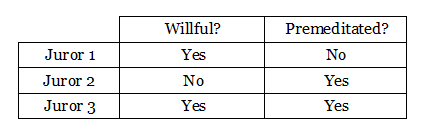
You’re overseeing a murder trial. The defendant will be hanged if his crime is judged to be both willful and premeditated. You poll the jurors:
doctrinal paradox

A majority think it was willful, and a majority think it was premeditated, so you order the death penalty. As he’s dragged off to the gallows, the defendant screams that this is unfair and swears that his ghost will return for revenge.

You think nothing more of this until that evening, when a strange thought occurs to you. If you’d simply asked the jurors, “Should this man receive the death penalty?”, most would have voted no — only one of the three jurors believed that the crime was both willful and premeditated. Was your own reasoning unsound?

And who’s that behind you — ?


Vide Infra

Posted in Oddities, Poems by Greg Ross on January 31st, 2009

Edward Edwin Foot was a poet with the mind of an attorney — in his 1865 elegy for Henry Temple, a single verse contains three footnotes:

Altho’ we* mourn for one now gone,
And he — that grey-hair’d Palmerston,†
We will give God the praise,–
For he, beyond the age of man,‡
Eleven years had over-ran
Within two equal days.

*The nation.
†The Right Honourable Henry John Temple, Viscount Palmerston, K.G., G.C.H., &c. (the then Premier of the British Government), died at “Brockett Hall,” Herts, at a quarter to eleven o’clock in the forenoon of Wednesday, 18th October, 1865, aged eighty-one years (all but two days, having been born on the 20th October 1784). The above lines were written on the occasion of his death.
‡Scriptural limitation.


Unquote

Posted in Quotations by Greg Ross on January 30th, 2009

“Many might go to heaven with half the labor they go to hell.” — Ben Jonson


The Rich Are Different

Posted in Oddities by Greg Ross on January 30th, 2009

http://en.wikipedia.org/wiki/File:Belcourt1895.jpg

Oliver Belmont loved horses so much that he shared his house with them. When planning his summer mansion in Newport, R.I., in 1891, the American socialite insisted that the first floor be devoted to stables, paneled in teak and heated with steam, with quarters for eight grooms. The family lived on the second floor.

That’s not all. Reportedly Belmont’s horses had morning clothes, afternoon clothes, and evening clothes; slept in white linen sheets; and had harness hooks made of sterling silver. Belmont couldn’t bear to part with two of his favorites even at their death, so he had them stuffed and mounted in a drawing room.

“It’s your client’s money you’re spending,” wrote architect Richard Morris Hunt. “If they want you to build a house upside down standing on its chimney, it’s up to you to do it, and still get the best possible results.”


Math Notes

Posted in Science & Math by Greg Ross on January 29th, 2009

2502 = 2 + 502


Oh, Never Mind

Posted in Literature, Science & Math by Greg Ross on January 29th, 2009

Zhuangzi and Huizi were strolling along the dam of the Hao Waterfall when Zhuangzi said, ‘See how the minnows come out and dart around where they please! That’s what fish really enjoy!’

Huizi said, ‘You’re not a fish — how do you know what fish enjoy?’

Zhuangzi said, ‘You’re not I, so how do you know I don’t know what fish enjoy?’

Huizi said, ‘I’m not you, so I certainly don’t know what you know. On the other hand, you’re certainly not a fish — so that still proves you don’t know what fish enjoy!’

Zhuangzi said, ‘Let’s go back to your original question, please. You asked me how I know what fish enjoy — so you already knew I knew it when you asked the question. I know it by standing here beside the Hao.’

Zhuangzi, China, fourth century B.C.


Walking Wounded

Posted in Literature by Greg Ross on January 28th, 2009

http://commons.wikimedia.org/wiki/File:Paget_holmes.png

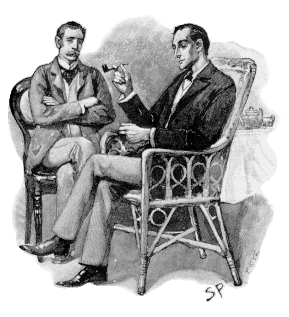
John Watson, the companion and biographer of Sherlock Holmes, was hit by a Jezail bullet while serving with the British army in Afghanistan.

Curiously, though, the wound migrates.

In “A Study in Scarlet” (1887), Watson says he was struck in the shoulder, but in “The Sign of Four” (1890) the wound has moved to his leg, which Watson says aches at changes in the weather.

One would think that this might have drawn Watson’s attention, as he was a medical doctor. But evidently he lacked his friend’s perspicacity — in “The Adventure of the Noble Bachelor” (1892) he refers only to a bullet wound in “one of my limbs.”


Spanagrams

Posted in Language, Science & Math by Greg Ross on January 28th, 2009

Arithmetic is easy in Spanish — just rearrange letters:

UNO + CATORCE = CUATRO + ONCE

DOS + TRECE = TRES + DOCE


In a Word

Posted in Language by Greg Ross on January 27th, 2009

spaneria
n. a scarcity of men

spanogyny
n. a scarcity of women


Sound Over Sense

Posted in History by Greg Ross on January 27th, 2009

http://commons.wikimedia.org/wiki/File:Warren_G_Harding_portrait_as_senator_June_1920.jpg

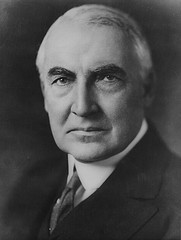
“I would like the government to do all it can to mitigate, then, in understanding, in mutuality of interest, in concern for the common good, our tasks will be solved.”

That’s Warren G. Harding, and God knows what he meant. Harding’s utterances were so impenetrable that they developed a sort of fascinated following. “He writes the worst English that I have ever encountered,” wrote H.L. Mencken, who dubbed it Gamalielese. “It is so bad that a sort of grandeur creeps into it. It drags itself out of the dark abysm of pish, and crawls insanely up the topmost pinnacle of posh. It is rumble and bumble. It is flap and doodle. It is balder and dash.”

When Harding succumbed to a stroke in 1923, E.E. Cummings wrote, “The only man, woman, or child who wrote a simple declarative sentence with seven grammatical errors is dead.”