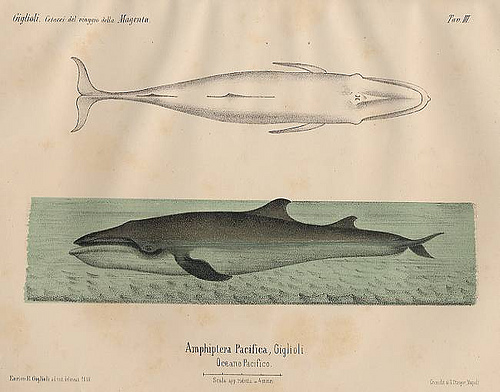
Giglioli’s Whale

In 1867, off the coast of Chile, zoologist Enrico Giglioli spotted a whale with two dorsal fins, a feature unheard of in any known whale.
A similar whale was spotted off Scotland in 1868, and another more than a century later near Corsica.
If "Giglioli's whale" exists, it's been spotted only three times, and no specimen, living or dead, and has ever been captured.
See also MacFarlane's Bear.
In a Word
aidle
v. "to earn one's bread indifferently well"
(Charles Mackay, Lost Beauties of the English Language, 1874)
Help Wanted
H. Hamilton, once the proprietor of Payne's Hill, near Cobham, Surrey, advertised for a person who was willing to become a hermit in that beautiful retreat of his. The conditions were, that he was to continue in the hermitage seven years, where he should be provided with a Bible, optical glasses, a mat for his bed, a hassock for his pillow, an hour-glass for his timepiece, water for his beverage, food from the house, but never to exchange a syllable with the servant. He was to wear a camlet robe, never to cut his beard or nails, nor ever to stray beyond the limits of the grounds. If he lived there, under all these restrictions, till the end of the term, he was to receive seven hundred guineas. But on breach of any of them, or if he quitted the place any time previous to that term, the whole was to be forfeited. One person attempted it, but a three weeks' trial cured him.
– Robert Conger Pell, Milledulcia, 1857
“King, Queen, Knave”: Solution

Solution to King, Queen, Knave:
White's last move must have been an underpromotion, with a pawn on d7 capturing a knight on c8. If we retract that move we get the position above, and if the pawn instead now captures the rook on e8 and promotes to a knight, it gives mate. This is the only legal possibility that meets the requirements of the problem.
Nabokov writes, "There is some mild magic in the retrospective transformation of White R into Black Kt, and Black R into White Kt, with the symmetry of the pieces (and White's defense of c7) retained."
The Bach Motif

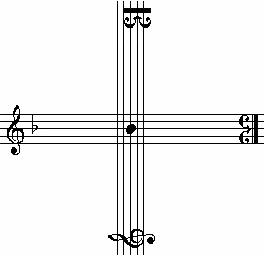
Bach's name forms a musical motif. The German note B is equivalent to the English B-flat, and H indicates B natural. So if you revolve this cross counterclockwise, the note at the center takes successively the German values B (treble clef), A (tenor clef), C (alto clef), and H (treble clef).
Bach himself used the four-note motif as a subject in The Art of Fugue, and it's appeared since in works by Schumann, Liszt, Rimsky-Korsakov, Poulenc, and Webern.
Waltzing Solitaire

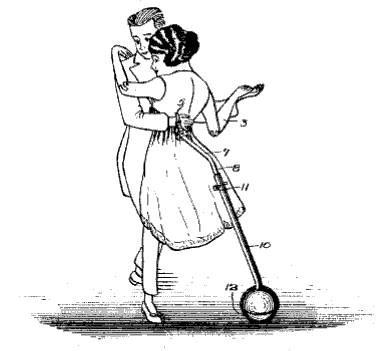
Sad and creepy, yes, but it saves money on corsages.
Sidney Feist patented this "figure for ballroom dancing practice" in 1921.
Maiden Voyage
On Aug. 10, 1628, as hundreds of Swedish spectators looked on, the new royal warship Vasa crossed the Stockholm waterfront, set her sails, foundered, and sank.
She covered less than 1 nautical mile.
Problem Solved
Epimenides, a Cretan, says that all Cretans are liars. This seems to create a paradox: If his statement is true, then it's false, and vice versa.
The idea recurs in Paul's epistle to Titus: "One of themselves, even a prophet of their own, said, The Cretians are alway liars, evil beasts, slow bellies. This witness is true."
But Aristotle, being Aristotle, sees right through the difficulty: "There is no impossibility in supposing that the man habitually lies, but that in this particular instance (in the proclamation of his own mendacity) he is telling the truth."
“Cupid’s Arithmetic”: Solution
Solution to Cupid's Arithmetic:
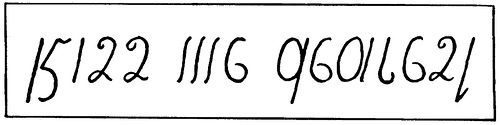
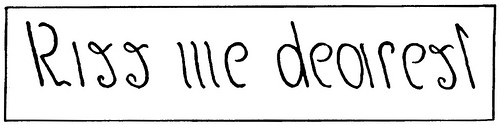
All the young mathematician had to do was to reverse the paper and hold it up to the light, or hold it in front of a mirror, when he would immediately see that his betrothed's curious jumble of figures will read:

Unquote
"No man was ever wise by chance." — Seneca