
Futility Closet

Auroral Sounds

Posted in Oddities by Greg Ross on October 31st, 2006

http://commons.wikimedia.org/wiki/Image:Polarlicht_2.jpg

Ever since ancient Rome, people have reported hearing the aurora borealis. It’s been described as a crackling, hissing, buzzing, or whistling.

Modern science can’t explain such sounds (yet), and so far no one’s managed to record them, so for now the jury’s still out.


Doomsday Clock

Posted in Science & Math, Society by Greg Ross on October 31st, 2006

Every issue of the Bulletin of the Atomic Scientists since 1947 has displayed a clock face on its cover, symbolizing the world’s proximity to nuclear war (in the judgment of the bulletin’s board of directors).

At its most dire, the clock stood at two minutes to midnight in 1953, when the United States and the Soviet Union tested thermonuclear devices within nine months of one another. Thirty-eight years later, when the superpowers signed the START treaty in 1991, the clock reached 17 minutes to midnight, its most hopeful position to date.

That doesn’t mean we’re making progress. Today it stands at 7 minutes to midnight — which is just where it started 59 years ago.


Field Work

Posted in History by Greg Ross on October 30th, 2006

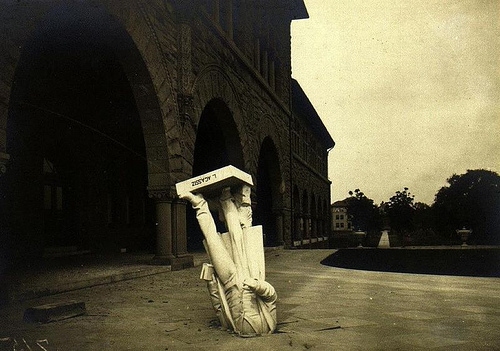
http://commons.wikimedia.org/wiki/Image:Agassiz_statue.jpg

Stanford University after the earthquake of 1906.

The statue is of Louis Agassiz … who studied geology.


In a Word

Posted in Language by Greg Ross on October 30th, 2006

ucalegon
n. a neighbor whose house is on fire


Charley Parkhurst

Posted in History, Society by Greg Ross on October 30th, 2006

Excerpt from an obituary for stagecoach driver Charley Parkhurst, published in the San Francisco Morning Call, Dec. 28, 1879:

He was in his day one of the most dexterous and celebrated of the famous California drivers ranking with Foss, Hank Monk, and George Gordon, and it was an honor to be striven for to occupy the spare end of the driver’s seat when the fearless Charley Parkhurst held the reins of a four- or six-in-hand …

It was discovered only afterward that “One-Eyed Charlie” had been a woman, born Charlotte Darkey Parkhurst in New Hampshire in 1812. Posing as a man, she had gained a reputation as one of the best stagecoach drivers on the West Coast.

More than that, her name (as Charles Darkey Parkurst) is listed in the Santa Cruz voter rolls for Oct. 17, 1868 — which means she may have been the first woman to vote in the United States.


The Owl House

Posted in Art by Greg Ross on October 29th, 2006

http://commons.wikimedia.org/wiki/File:Owl_house_2003_01.JPG

Deciding that her life was “dull,” Helen Martins went a little crazy in 1945 and began filling her garden with sculptures of owls, camels and people. She said she drew her inspiration from Blake, the Bible and Omar Khayyam, but she also pointed most of the figures eastward to reflect an obsession with the Orient. And she decorated the house’s interior walls with crushed glass.

Martins was derided during her lifetime, but the house has been preserved and is now a national monument in South Africa.

(Image: Wikimedia Commons)


Love Padlocks

Posted in Oddities, Society by Greg Ross on October 28th, 2006

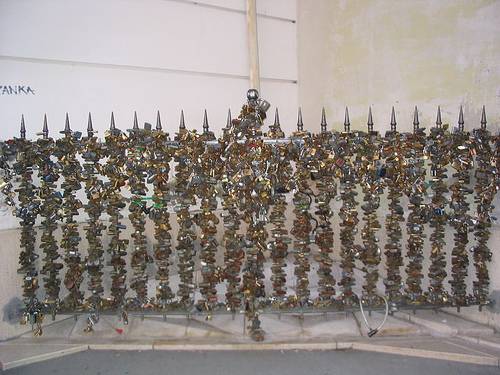
http://commons.wikimedia.org/wiki/Image:P%C3%A9csi_szerelmes_lakatok.jpg

In the 1980s, in the Hungarian city of Pécs, lovers began to clamp padlocks to this wrought-iron fence as a symbol of their commitment.

Now that the fence has filled up, people have begun attaching locks to fences and statues throughout the town center, and the custom has spread to Hungary, Latvia, Italy and Japan.

“Love is a lock that linketh noble minds,” wrote Robert Greene, “faith is the key that shuts the spring of love.”


August Natterer

Posted in Art by Greg Ross on October 27th, 2006

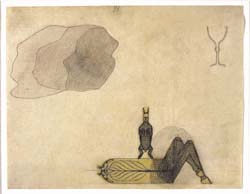
http://commons.wikimedia.org/wiki/Image:August_Natterer_Neter_artwork_1919.jpg

Schizophrenic artist August Natterer (1868-1933) may have been a visionary, but it’s hard to tell.

For example, in this drawing, Axel of the World, With Rabbit (1919), he said that the rabbit represents “the uncertainty of good fortune. It began to run on the roller … the rabbit was then changed into a zebra (upper part striped) and then into a donkey (donkey’s head) made of glass. A napkin was hung on the donkey; it was shaved.”

Seneca wrote, “There is no great genius without some touch of madness.”


Limerick

Posted in Humor, Language, Poems by Greg Ross on October 27th, 2006

There was a young lady named Susie
Whose surname said she was a floozie.
Cathouse was the name;
It caused her such shame
She chose to pronounce it Cathouse.


Bullseye

Posted in Science & Math by Greg Ross on October 27th, 2006

0.999… is the same as 1. Not just very close, but precisely identical:

a = 0.999…
10a = 9.999…
10aa = 9.999… – 0.999…
9a = 9
a = 1

There’s no trick here. It’s just a mathematical fact that most people find deeply counterintuitive.