
Month: December 2011
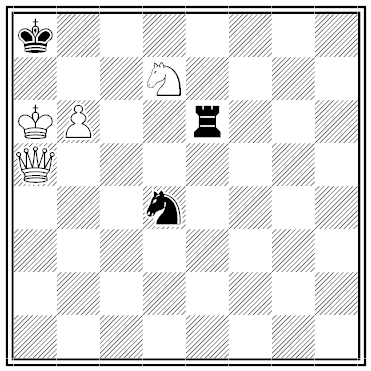
“A Tragic Calendar”
JANet was quite ill one day.
FEBrile troubles came her way.
MARtyr-like she lay in bed;
APRoned nurses softly sped.
“MAYbe,” said the leech judicial,
“JUNket would be beneficial.”
JULeps, too, though freely tried,
AUGured ill, for Janet died.
SEPulcher was sadly made;
OCTaves pealed and prayers were said.
NOVices with many a tear
DECorated Janet’s bier.
— Carolyn Wells, Folly for the Wise, 1904
Cheaters’ Chopsticks
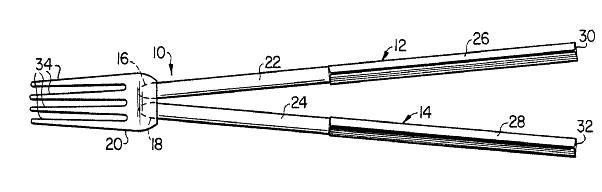
In 1987, Gerald L. Printz addressed a familiar problem:
The use of chopsticks requires a great deal of dexterity, making their use impossible by those without training, and often making their use undesirable by those who do not use them regularly, but who do not wish to risk the embarrassment of dropping or otherwise mishandling the food they are eating. … Accordingly, those wishing to avoid embarrassment while eating often must break with Oriental custom by opting for the less-embarrassing and less enjoyable alternative of using Western-style utensils when eating Oriental cuisine.
Printz’s invention solves this by adding detachable Western-style utensil heads (forks, spoons, etc.) to the sticks’ ends, “which does not require the skilled manipulation of chopsticks.” He notes that even skilled users of chopsticks might prefer this when eating rice or noodles, “due to the tweezerlike manner in which chopsticks grasp such foods.”
Invention
To find a rhyme for silver
Or any “rhymeless” rhyme
Requires only will, ver-
Bosity and time.
— Stephen Sondheim
Round Trip
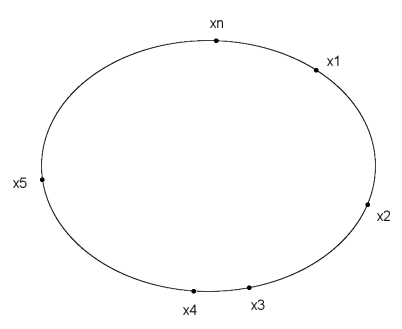
A problem by Hungarian mathematician Laszlo Lovász:
A track has n arbitrarily spaced fuel depots. Each depot contains a quantity of gasoline; the total amount of gas is exactly enough to take us around the track once. Prove that, no matter how the gas is distributed, there will be a depot at which an empty car can fill up, proceed around the track picking up gas at each depot, and complete a full round trip back to its starting depot.
Occupational Privilege
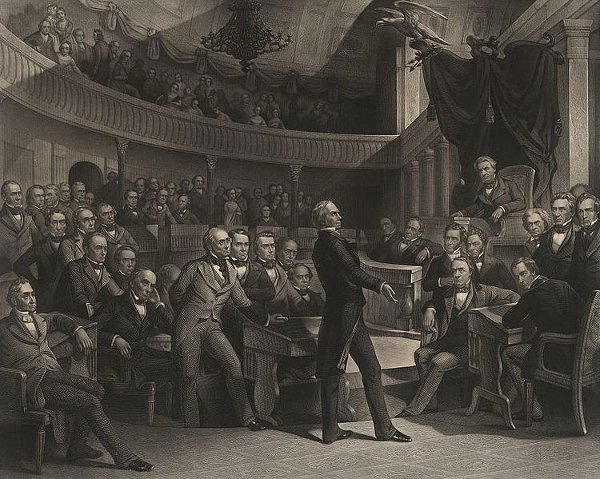
A member of Congress can’t be sued for libel and slander for anything he says on the floor of the House or Senate. This immunity extends to committee hearings and to material he publishes in the Congressional Record.
The framers of the Constitution wanted to protect legislators from the harassment that critics of the British king had suffered in Parliament.
Survival of the Fittest
In 1499, a bear which had been terrorizing a German village and had killed people, was captured and brought to trial. The attorney appointed to defend the bear was allowed to argue for days that the animal had the right to be judged by a jury of its peers (that is, other bears). However, the animal was tried and convicted by human beings. It was sentenced to dangle from the public gallows until relatives of its victims stoned the bear to death.
— Thomas J. Gardner and Victor Manian, Criminal Law: Principles, Cases and Readings, 1975
Table and Tumblers
This problem originated in Russia, according to various sources, but no one’s sure precisely where:
Before you is a square table that can rotate freely. In each corner is a deep well, at the bottom of which is a tumbler that’s either upright or inverted. You can’t see the tumblers, but you can reach into the wells to feel their positions.
Periodically the table rotates and stops at random. After each stop, you can feel two of the tumblers and turn over either, both, or neither. If all four of the tumblers are in the same state — all upright or all inverted — then a bell sounds. Otherwise the table rotates again and you make another “move.”
Can you guarantee to ring the bell in a finite number of moves? If so, how?
In a Word
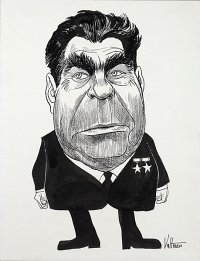
glabella
n. the space between the eyebrows
cejijunto
n. a person with one long continuous eyebrow