
Sound Sense

http://books.google.com/books?id=VAevYgEACAAJ&d

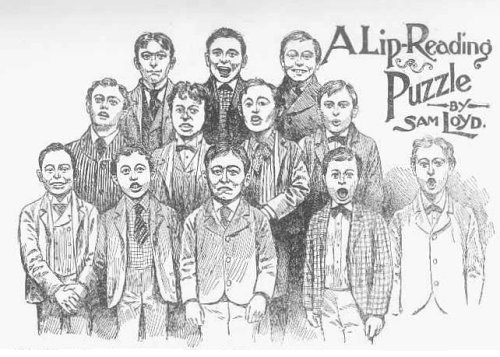
Here is a class of a dozen boys, who, being called up to give their names were photographed by the instantaneous process just as each one was commencing to pronounce his own name. The twelve names were Oom, Alden, Eastman, Alfred, Arthur, Luke, Fletcher, Matthew, Theodore, Richard, Shirmer, and Hisswald. Now it would not seem possible to be able to give the correct name to each of the twelve boys, but if you practice the list over to each one, you will find it not a difficult task to locate the proper name for every one of the boys.
Click for Answer

Misc

  • Newton was born the year that Galileo died.
  • Cole Porter’s summer home was called No Trespassing.
  • 66339 = (6 × 6)3 + 39
  • Could you have had different parents?
  • “A good conscience is a continual Christmas.” — Ben Franklin

UPDATE: The first item here is incorrect. The dates coincide only if one uses the Gregorian calendar to date Galileo’s death and the Julian to date Newton’s birth. The two events occurred 361 days apart, which puts them in separate years on both calendars. Apparently this is a very common error. (Thanks, Igor.)

“No!”

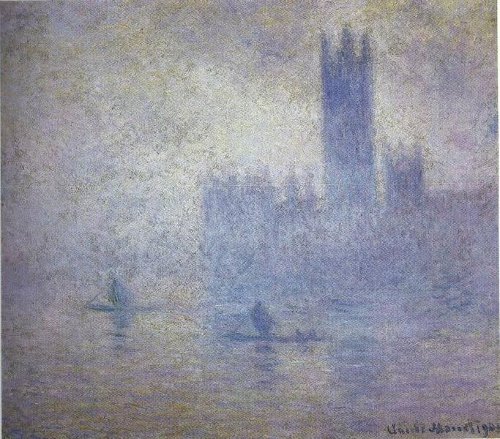
http://commons.wikimedia.org/wiki/File:Brouillard,_London_Parliament,_Claude_Monet.jpg

No sun — no moon!
No morn — no noon —
No dawn — no dusk — no proper time of day —

No sky — no earthly view —
No distance looking blue —
No road — no street — no “t’other side the way ” —

No end to any Row —
No indications where the Crescents go —
No top to any steeple —
No recognitions of familiar people —

No courtesies for showing ’em —
No knowing ’em!
No travelling at all — no locomotion,
No inkling of the way — no notion —

“No go” — by land or ocean —
No mail — no post —
No news from any foreign coast —
No park — no ring — no afternoon gentility —

No company — no nobility —
No warmth, no cheerfulness, no healthful ease,
No comfortable feel in any member —
No shade, no shine, no butterflies, no bees,
No fruits, no flowers, no leaves, no birds,

November!

— Thomas Hood, in The Book of Days, 1832