What is the product of this series?
(x – a) (x – b) (x – c) … (x – z)
This yields to an insight, so I’ll withhold the answer.

What is the product of this series?
(x – a) (x – b) (x – c) … (x – z)
This yields to an insight, so I’ll withhold the answer.
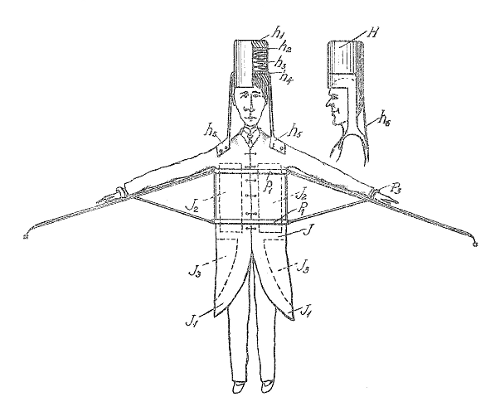
Hungarian inventor Michael Kispéter offered this safety suit for air travelers in 1915 — a jacket lined with inflatable cushions, a torso-mounted parachute, and a helmet fitted with a spring:
A person falling from the air, equipped with my life saving apparatus, will first open the parachute … Should the person fall into water, the air-cushions will keep him or her afloat, and should the respective person fall on land and the parachute not assure a descent smooth enough to prevent a violent impact with same, the impact will considerably be reduced also by the air cushions. Should the person fall head foremost the sides of the helmet will break on contact with the soil and the resilient means contained in the helmet will mitigate the concussion.
I can’t tell whether Kispéter ever tested his contraption, but he’s not the only inventor who was thinking along these lines.
In 1939, University of Iowa graduate student Mary Tudor began an experiment with local orphans, warning them that they were showing signs of stuttering and lecturing them whenever they repeated a word. The children became acutely self-conscious, and many began to stutter, fulfilling the theory that “the affliction is caused by the diagnosis.”
Sixty years later, when Tudor was 84, she received a letter from one of the orphans. It was addressed to “Mary Tudor Jacobs The Monster.”
“You destroyed my life,” it ran. “I could have been a scientist, archaeologist or even president. Instead I became a pitiful stutterer. The kids made fun of me, my grades fell off, I felt stupid. Clear into my adulthood, I still want to avoid people to this day.”
“I didn’t like what I was doing to those children,” Tudor told the San Jose Mercury News in 2001. “It was a hard, terrible thing. Today, I probably would have challenged it. Back then you did what you were told. It was an assignment. And I did it.”