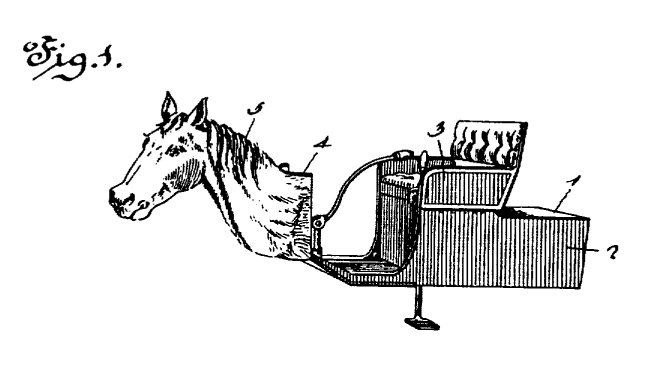
Michigan inventor Uriah Smith patented the Horsey Horseless in 1899. He hoped that an automobile that bore a wooden horse’s head would be less likely to spook animals in the road.
For all we know he was right. Maybe we should still be using these.

Michigan inventor Uriah Smith patented the Horsey Horseless in 1899. He hoped that an automobile that bore a wooden horse’s head would be less likely to spook animals in the road.
For all we know he was right. Maybe we should still be using these.
Egbert de Vries, a Dutch sociologist, has told of how the introduction of matches to an African tribe altered their sexual habits. Members of this community believed it necessary to start a new fire in the fireplace after each act of sexual intercourse. This custom meant that each act of intercourse was something of a public event, since when it was completed someone had to go to a neighboring hut to bring back a burning stick with which to start a fresh fire. Under such conditions, adultery was difficult to conceal, which is conceivably why the custom originated in the first place. The introduction of matches changed all this. It became possible to light a new fire without going to a neighbor’s hut, and thus, in a flash, so to speak, a long-standing tradition was consumed.
“In reporting on de Vries’ finding, Alvin Toffler raises several intriguing questions: Did matches result in a shift in values? Was adultery less or more frowned upon as a result? By facilitating the privacy of sex, did matches alter the valuation placed upon it?”
— Neil Postman, Technopoly, 1992, citing Toffler’s introductory essay “Value Impact Forecaster — A Profession of the Future” in Kurt Baier and Nicholas Rescher’s Values and the Future (1969)
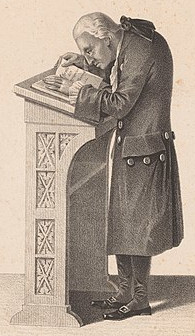
Immanuel Kant held up his stockings using suspenders of his own devising. From his friend Ehregott Wasianski:
On this occasion, whilst illustrating Kant’s notions of the animal economy, it may be as well to add one other particular, which is, that for fear of obstructing the circulation of the blood, he never would wear garters; yet, as he found it difficult to keep up his stockings without them, he had invented for himself a most elaborate substitute, which I shall describe. In a little pocket, somewhat smaller than a watch-pocket, but occupying pretty nearly the same situation as a watch-pocket on each thigh, there was placed a small box, something like a watch-case, but smaller; into this box was introduced a watch-spring in a wheel, round about which wheel was wound an elastic cord, for regulating the force of which there was a separate contrivance. To the two ends of this cord were attached hooks, which hooks were carried through a small aperture in the pockets, and so passing down the inner and the outer side of the thigh, caught hold of two loops which were fixed on the off side and the near side of each stocking.
“As might be expected, so complex an apparatus was liable, like the Ptolemaic system of the heavens, to occasional derangements; however, by good luck, I was able to apply an easy remedy to these disorders which sometimes threatened to disturb the comfort, and even the serenity, of the great man.”
(Ehregott Andreas Wasianski, Immanuel Kant in seinen letzten Lebensjahren, 1804, via Thomas De Quincey, “The Last Days of Immanuel Kant,” 1827.)
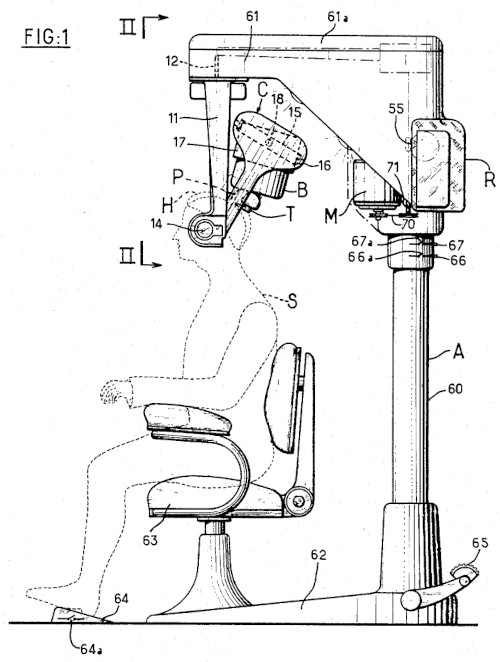
Why didn’t this catch on? Jean Gronier’s “automatic hair-cutting machine,” patented in 1966, works “in accordance with a predetermined program; each program is designed for a particular person and is established once and for all with a view to obtaining repeatedly the same cut for the same head.”
“Here I am, bald at last,” wrote Jules Renard in 1894. “So much the better! What use to me was hair? It was not exactly an ornament, and I was the natural victim of all barbers, an ignoble breed, who exhaled into my face their disdain, or caressed me like a mistress, or patted my cheek like a parish priest.”
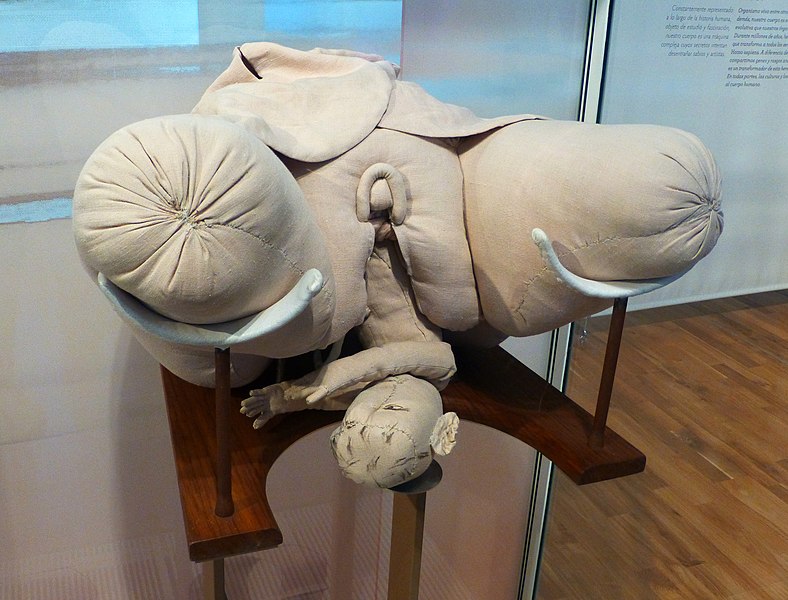
The first life-size obstetrical mannequin was invented by French midwife Angélique du Coudray, who was using it to demonstrate the process of childbirth as early as 1756:
I announced that I would gladly give my advice to poor women who needed it. … I took the tack of making my lessons palpable by having them maneuver in front of me on a machine I constructed for this purpose, and which represented the pelvis of a woman, the womb, its opening, its ligaments, the conduit called the vagina, the bladder and rectum intestine.
The upholstered model included a womb and an extractable baby doll with which her students could practice. The skin and soft organs were made of flesh-colored linen and leather stuffed with padding, and some of the bones were assembled from real skeletons, though wood and wicker later took their place.
“The model is meant mostly for maneuvers that, as others confirm, allow her students to gain confidence, be ‘encouraged, and succeed perfectly,'” writes Nina Rattner Gelbart in The King’s Midwife (1998). “Delivering babies from every conceivable position and presentation will prepare her students for all eventualities. … This machine, as the midwife’s followers will continue to testify, makes an ‘impression that can never be erased,’ ‘an advantage all the more essential because this class of surgeons and these women [of the countryside] do not have the resource of reading … [so] these daily continual maneuvers … [must be] vividly impressed on their senses.'”
Trained on 11,000 early modern texts in English, French, and Latin, MonadGPT is a chatbot with the language and style (and limited knowledge) of the 17th century:
User: What are the planets of the solar system?
Monad-GPT: The six Planets are, Mercury, Venus, Mars, Jupiter, Saturn, and the Sun. The Moon is also a Planet; which being of so great Influence upon Earth, makes it to be most admired of all others by Astronomers.
User: Why has the Moon such an influence upon Earth?
Monad-GPT: But the Moon is so neer to us, as almost to be part of Earth; and therefore it much influences our Atmosphere. This Influence makes all that are in any way affected by Air, to be more under her influence than any other Planet. For if there were a little more or less Matter in the Air, than there is now, we should never have such Plants and Creatures as there are upon Earth: for every Plant and Creature hath its proper Temperature necessary for its Existence. If the Sun did not make up this shortage by his warmth from without, we should be destroyed.
User: Can you write a poem about the Moon?
Monad-GPT: O fairest Moon, that from the Heav’n dost shine, / In her own Lustre all the World does find: / As in thine Orb, where all is bright and clear, / The Sun himself is not more pure than thee.
User: How could we travel to the Moon? With a big canon?
Monad-GPT: But how to travel from Earth to the Moon, with our present Engines? A very hard Question: for we are like those that would go to Heaven in a Basket: We have no Wings, and God hath not given us any Angels to bear us up. Therefore I will leave this Enquiry to others; and end my Discourse of the Moon.
Via MetaFilter.
Watch this footage and try to guess when it was recorded.
Amazingly, it’s from 1902. The cities of Elberfeld and Barmen in western Germany had begun to discuss an elevated railway as early as 1887; they enlisted engineer Eugen Langen, and the line opened in 1901.
The Wuppertal Schwebebahn is still in use today — the world’s oldest electric suspension railway carries 85,000 passengers a day on an eight-mile route through the city of Wuppertal, much of the journey unfolding 12 meters above the River Wupper. Local poet Else Lasker-Schüler compared it to a flight on the back of a steely dragon.
(Thanks, Nick.)
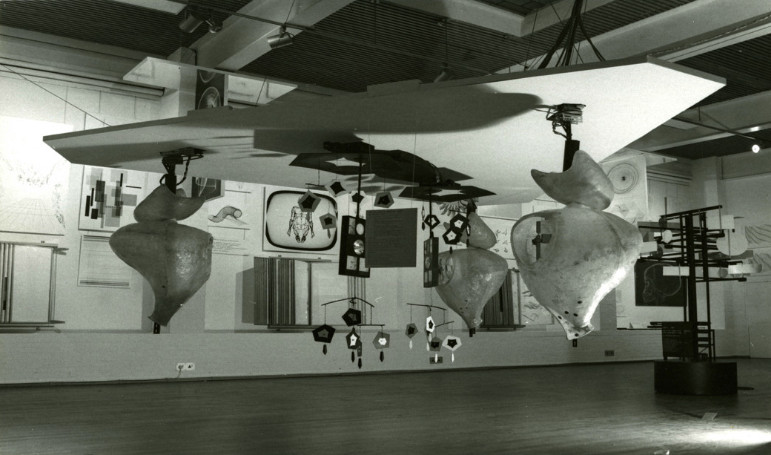
For the 1968 exhibition Cybernetic Serendipity in London, inventor Gordon Pask created a society of mobiles, two “males” and three “females” that had to learn to communicate, cooperate, and compete in order to satisfy their drives. The males could project light beams, and the females could, if they chose, reflect a beam back to the sending male, which he desired. The males had to compete with one another to find cooperative females, and the females competed to find males projecting suitably colored light.
Male I sends out an intermittent directional visual signal which serves to identify it as ‘male I’ and its desire as ‘O [orange] satisfaction.’ … Should the directional signal fall on the receptor of a female who is trying to cooperate, she produces an identifying sound in synchrony with the intermittent light signal. Male I detects the correlation between the female and his light signal and stops his motion (unless he is prevented from doing so by male II). At this point he triggers off an autonomous energetic event which consists in shining an intense orange light for at least a minimum interval in the direction of the located female. The immediate result is an increase of the O drive. However, male I anticipates reinforcement (which he will achieve if the female behaves appropriately and if the moving part, C, is appropriately positioned during at least some of this behaviour). Reinforcement, which substantially reduces the O drive, is obtained if the O goal is satisfied; that is if orange light falls on receptor C. Supposing reinforcement occurs, male I emits an identifying sound signal which is received by the cooperating female, the autonomous energetic event is prolonged and the O drive is decreased.
“The cooperative encounter terminates after a short time if reinforcement does not occur, or if it is externally disrupted. Otherwise it continues until the drive state of male I is modified so that he aims for a different goal.”
Pask stressed that the mobiles needed to learn from experience in order to satisfy their drives. The females had to learn how to position their reflectors to attract males, but the system encouraged them to find different strategies so that not all males demanded stimulation of the same receptor. Pask said, “Some may like O light on D and P [puce] light on C. She can learn that trick also.”
(From Paul Brown, et al., eds., White Heat Cold Logic: British Computer Art 1960-1980, 2008.)
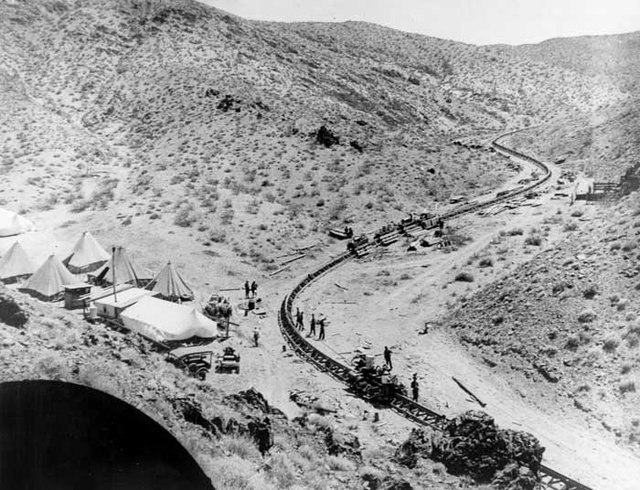
A late odd railway: In 1922 a Los Angeles florist built a 28-mile monorail to carry hydrated magnesium sulphate from the Owlshead Mountains to a siding of the Trona Railway in San Bernardino County, California. Steel-framed locomotives crawled along a steel rail pulling carriages bearing low-slung loads like saddlebags. Its downhill speed touched 56 mph, briefly earning it the epithet “fastest monorail of the world,” but the beams warped as they dried, landslides further damaged the track, and the railway shut down in 1926, just two years after opening.
“In the late 1930s the rails were salvaged and sold for scrap, and the longitudinal timbers followed suit,” writes John Day in More Unusual Railways (1960). “In 1958 a long line of ‘A’ frames still marched across the wastes to show where the line once had run.”
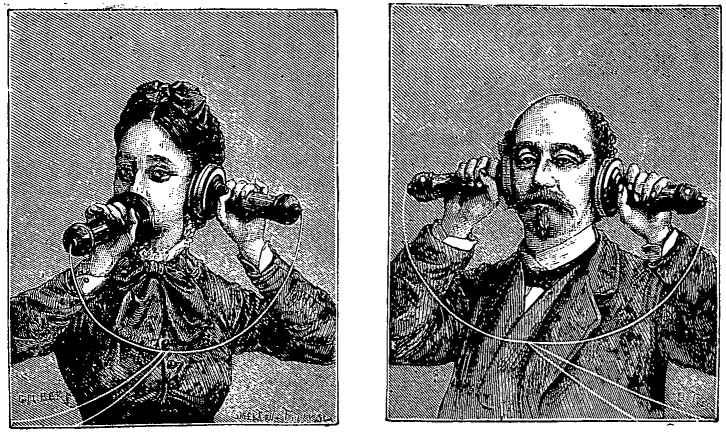
A Canadian notice to new telephone users, 1896:
To Listen: Place the telephone fairly against the ear, with an upward motion, so that the lower extremity or lobe of the ear is gathered in, into the cavity of the telephone; in this position it will be found to fit snugly and comfortably — the lobe of the ear acting as a cushion and at the same time closing out all ulterior sounds, thus enabling the voice to be heard with clearness and precision.
One California instruction read, “Speak directly into the mouthpiece keeping mustache out of the opening.”
With no social conventions to follow, users had to be taught propriety. AT&T promoted a “Telephone Pledge” that read, “I believe in the Golden Rule and will try to be Courteous and Considerate over the Telephone as if Face to Face.” The winner of a 1910 Bell essay contest wrote, “Would you rush into an office or up to the door of a residence and blurt out ‘Hello! Hello! Who am I talking to?’ No, one should open conversations with phrases such as ‘Mr. Wood, of Curtis and Sons, wishes to talk with Mr. White …’ without any unnecessary and undignified ‘Hello’s.'”
In America Calling (1992), Claude S. Fischer notes, “Companies cut off service to abusers and obtained legislation that fined or even jailed profane customers.”
