
A mathematical oddity: Removing any of these four nails will cause the entire rope to fall.
By Flickr user fdecomite. More at the link below.
(Erik D. Demaine, et al., “Picture-Hanging Puzzles,” Theory of Computing Systems 54:4 [May 2014], 531-550.)

A mathematical oddity: Removing any of these four nails will cause the entire rope to fall.
By Flickr user fdecomite. More at the link below.
(Erik D. Demaine, et al., “Picture-Hanging Puzzles,” Theory of Computing Systems 54:4 [May 2014], 531-550.)
From Lee Sallows:
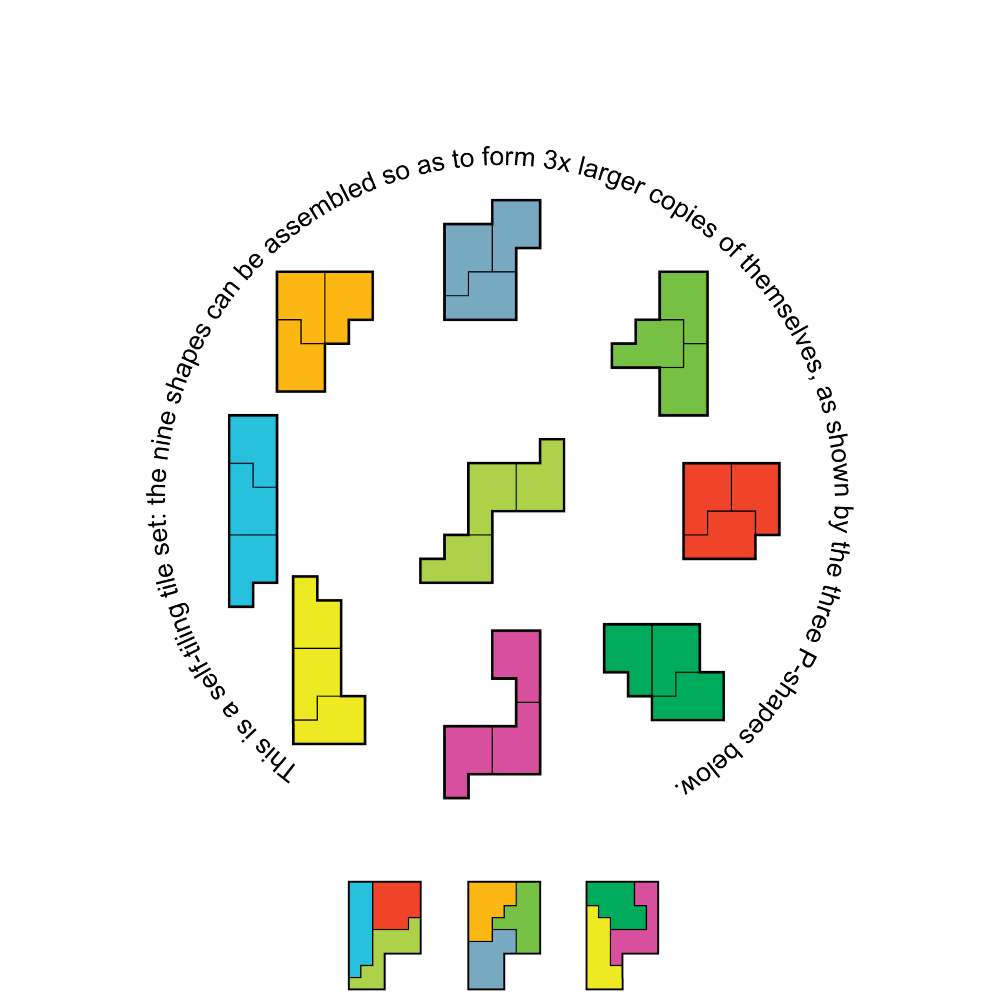
(Thanks, Lee!)
From reader Éric Angelini:
Call this S1:
FIRST, SECOND, THIRD, FOURTH, FIFTH, SIXTH, SEVENTH, EIGHTH, NINTH, TENTH, ELEVENTH, …
Consider it both a string of letters and a list of instructions: We are to underline the indicated letters, in order. That’s pretty straightforward — we’ll underline the first letter, then the second, then the third, and so on, ultimately reproducing S1.
Suppose we start the list with SIXTH, rather than FIRST. Now our first instruction is to underline the sixth letter, which is the S in SECOND. After that we underline the second letter in the string, as before, and the third, and so on. Only the very first letter, the F in FIRST, has been overlooked, and we can remedy that by putting FIRST in the sixth position in the list. With that swap all is well:
S6 = SIXTH, SECOND, THIRD, FOURTH, FIFTH, FIRST, SEVENTH, EIGHTH, NINTH, TENTH, ELEVENTH, …
Similarly, if the list starts with EIGHTH we can get everything underlined with just a single swap:
S8 = EIGHTH, SECOND, THIRD, FOURTH, FIFTH, SIXTH, SEVENTH, FIRST, NINTH, TENTH, ELEVENTH, …
Éric asks, “What about starting S9 with NINTH? How many swaps do we need to reproduce S9? This is more tricky!”
See the answer by Hans Havermann at the bottom of this page.
(Thanks, Éric.)
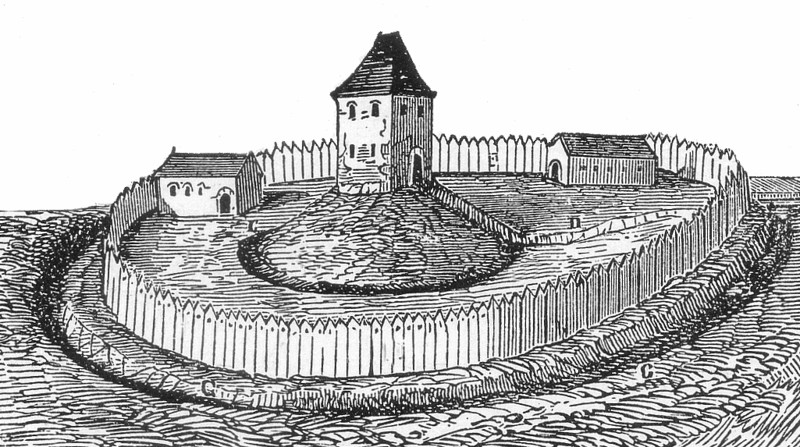
In 2005, philosopher Nicholas Shackel identified a form of argument in which an arguer claims to defend a controversial position while retreating, under pressure, to a more supportable one. He likened it to a medieval castle defense known as the motte and bailey, in which a stone tower, the motte, is surrounded by an area of open land, the bailey. If maurauders invade the bailey, the defender retreats to the motte, and when the attackers have given up he can reoccupy the bailey.
“For my purposes the desirable but only lightly defensible territory of the Motte and Bailey castle, that is to say, the Bailey, represents a philosophical doctrine or position with similar properties: desirable to its proponent but only lightly defensible,” Shackel wrote. “The Motte is the defensible but undesired position to which one retreats when hard pressed.”
By withdrawing as needed to a better-supported claim, a skilled arguer can pretend greater security than he’s established, and even accuse his critics of misrepresenting his position. Other writers have suggested that this is a common tactic in pseudoscience.
(Nicholas Shackel, “The Vacuity of Postmodernist Methodology,” Metaphilosophy 36:3 [April 2005], 295–320.)
The number 197 has a curious property:
1 + 9 + 7 = 17
9 + 7 + 17 = 33
7 + 17 + 33 = 57
17 + 33 + 57 = 107
33 + 57 + 107 = 197
After its n digits are used to initiate this pattern, the seeding number itself turns up in the resulting sequence. This makes 197 a Keith number, named for Mike Keith, the mathematician who first remarked on this property in 1987.
Keith numbers are rare and discovered only through exhaustive search, and progress stopped for 13 years after D. Lichtblau found the 34-digit 5752090994058710841670361653731519 in August 2009. But last December, while compiling a programming assignment, Ghent University mathematician Toon Baeyens found all the 35- and 36-digit Keith numbers:
23137274755282109912063039769168142
25314398891465125143523864790391288
44715370344837755402179510861188022
47933465320021485928519060435917729
196866601633638871239614307772203156
214860400509971669129437189647933258
394684240118372710589383926683340073
763701584467955209221750616718219223
880430656963418264331749765271577784
That last entry is now the largest Keith number known.
(Thanks, Peter.)
A digital animation by Catherine Leah Palmer.
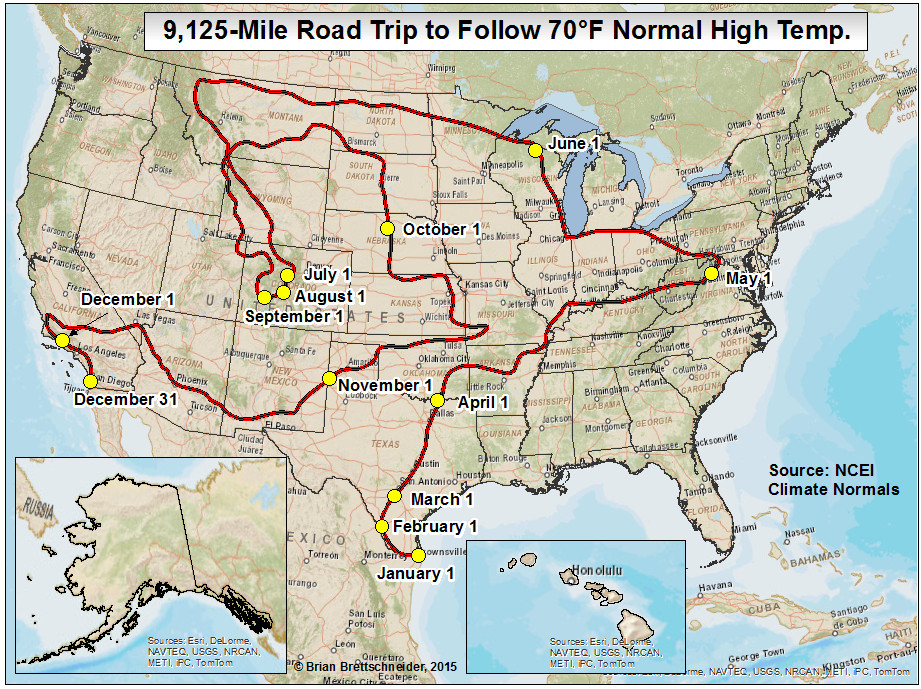
Reddit user Climatologist49 offered this map in 2015: By starting in Brownsville, Texas, on New Year’s Day and arriving at each waypoint on the day indicated, a heat-sensitive tourist could travel 9,125 miles (14,685 km) through the contiguous United States while experiencing a constant normal daytime high temperature of 70°F (21°C). They’d arrive in San Diego on New Year’s Eve. I wonder how much these temperatures have changed in eight years.
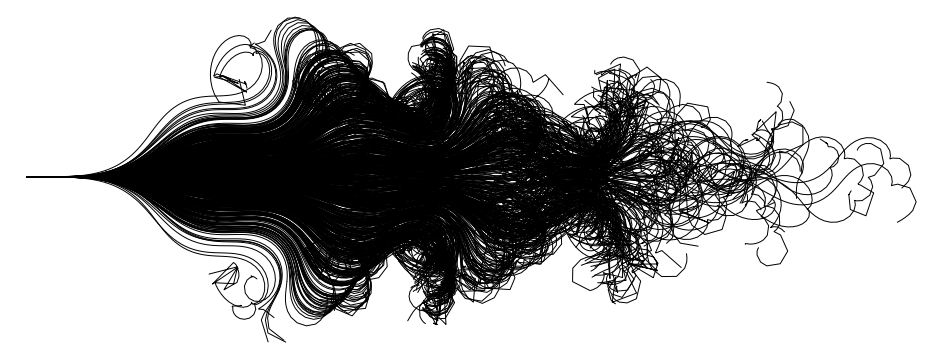
What is this? It’s the history of 800 successive unsteered bicycles, each traveling from left to right until it falls over. Caltech computer scientist Matthew Cook modeled the behavior in 2004, hoping to learn how we balance, steer, and correct our paths on two wheels. He found that just two artificial neurons were enough to control a bicycle competently — the system even learned to thread a series of waypoints:
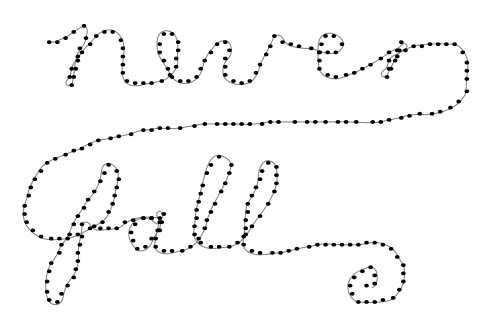
(Matthew Cook, “It Takes Two Neurons to Ride a Bicycle,” Demonstration at NIPS 4, 2004.) (Thanks, Dan.)
One other interesting item from Paul Halmos’ Problems for Mathematicians, Young and Old (1991): Pick a point in the first quadrant and draw a downward-sloping line through it. This line makes a triangle with the coordinate axes. At what angle should we set the line to minimize the area of the triangle?
This problem yields to calculus, but there’s a simple geometric solution. Reflect the axes through the point to make a box:
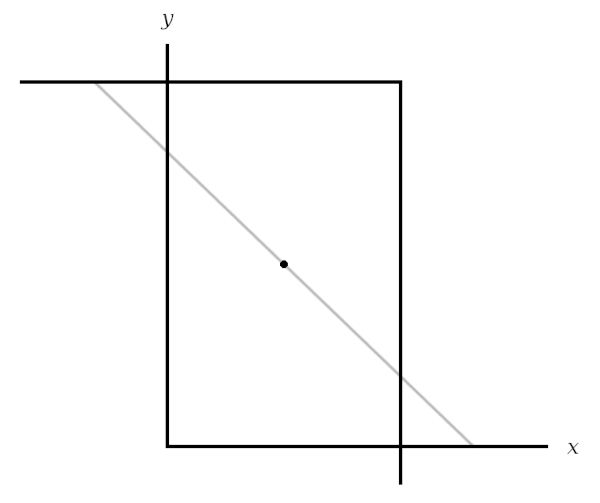
Now as we swivel our line through the point, it defines two triangles, one against each set of axes. The area of the combined triangles is equal to or greater than the area of the box. So, intuitively, it reaches a minimum just as the swiveling line becomes a diagonal of the box. That’s the answer.
Harry Mathews assembled lines from 14 existing sonnets to make a new one:
Shall I compare thee to a summer’s day
And dig deep trenches in thy beauty’s field?
Why lov’st thou that which thou receiv’st not gladly,
Bare ruin’d choirs where late the sweet birds sang?
Anon permit the basest clouds to ride
And do whate’er thou wilt, swift-footed Time:
Nor Mars his sword, nor war’s quick fire, shall burn
Even such a beauty as you master now.
Love’s not Time’s fool, though rosy lips and cheeks
(When other petty griefs have done their spite,
And heavily) from woe to woe tell o’er
That Time will come and take my love away;
For thy sweet love remembered such wealth brings
As any she belied beyond compare.
“This new poem sheds light on the structure and movement of the Shakespearean sonnet,” he wrote. “Nothing any longer can be taken for granted; every word has become a banana peel.”
(Harry Mathews, “Mathews’s Algorithm,” in Warren F. Motte, ed., Oulipo: A Primer of Potential Literature, 1998.)