Suppose I show you two old coins. One is dated 51 B.C., and the other is marked George I. Which is authentic?
|
SelectClick for Answer> |
Neither is authentic. No one in 51 B.C. could have foreseen the existence of Jesus of Nazareth, much less that he would arrive in exactly 51 years. And George would not have been called George I until it became necessary to distinguish him from George II (“Victoria” will not become “Victoria I” until we have a “Victoria II”).
|
Oct 24, 2007 | Categories: Puzzles
If you were a British soldier in Malta in the 19th century, you might receive this card from a local dram-shop:

What does it mean?
|
SelectClick for Answer> |
Puzzling Invitation:
Just read it straight through:
Here stop and spend a social hour
In harmless mirth and fun.
Let friendship reign, be just and kind,
And evil speak of none.
From William T. Dobson, Literary Frivolities, Fancies, Follies and Frolics, 1880.
See also Requiescat In Pace.
|
Oct 9, 2007 | Categories: Puzzles

From Amusements in Mathematics by Henry Ernest Dudeney (1917):
The men in the illustration are disputing over the liquid contents of a barrel. What the particular liquid is it is impossible to say, for we are unable to look into the barrel; so we will call it water. One man says that the barrel is more than half full, while the other insists that it is not half full. What is their easiest way of settling the point? It is not necessary to use stick, string, or implement of any kind for measuring. I give this merely as one of the simplest possible examples of the value of ordinary sagacity in the solving of puzzles. What are apparently very difficult problems may frequently be solved in a similarly easy manner if we only use a little common sense.
|
SelectClick for Answer> |

All that is necessary is to tilt the barrel as in Fig. 1, and if the edge of the surface of the water exactly touches the lip a at the same time that it touches the edge of the bottom b, it will be just half full. To be more exact, if the bottom is an inch or so from the ground, then we can allow for that, and the thickness of the bottom, at the top. If when the surface of the water reached the lip a it had risen to the point c in Fig. 2, then it would be more than half full. If, as in Fig. 3, some portion of the bottom were visible and the level of the water fell to the point d, then it would be less than half full.
This method applies to all symmetrically constructed vessels.
|
Oct 6, 2007 | Categories: Puzzles
Okay, I’ll ask three questions, and if you miss one I get your house. Fair enough? Here we go:
- A clock strikes six in 5 seconds. How long does it take to strike twelve?
- A bottle and its cork together cost $1.10. The bottle costs a dollar more than the cork. How much does the bottle cost?
- A train leaves New York for Chicago at 90 mph. At the same time, a bus leaves Chicago for New York at 50 mph. Which is farther from New York when they meet?
Don’t be hasty — your house is on the line.
|
SelectClick for Answer> |
1. A clock strikes six in 5 seconds. How long does it take to strike twelve?
Answer: Not 10 seconds, but 11 — one second per interval.
2. A bottle and its cork together cost $1.10. The bottle costs a dollar more than the cork. How much does the bottle cost?
Answer: Not $1.00, but $1.05.
3. A train leaves New York for Chicago at 90 mph. At the same time, a bus leaves Chicago for New York at 50 mph. Which is farther from New York when they meet?
Answer: Neither — when they meet they’ll be equally distant from anywhere, n’est-ce pas?
You’ll hear from my attorney.
|
Oct 4, 2007 | Categories: Puzzles
This question was proposed in the Scientific American, in 1868: ‘How many revolutions upon its own axis, will a wheel make in rolling once around a fixed wheel of the same size?’
The question brought to the editor of that paper many replies all claiming to have solved it. Yet the replies were about equally divided as to the number of revolutions, one part claiming one revolution and the other two revolutions. So much interest was manifested in it that Munn & Co. published The Wheel, June, 1868. It contains 72 pages, giving many of the solutions, illustrated by many diagrams.
– Miscellaneous Notes and Queries, August 1889
So who’s right?
|
SelectClick for Answer> |
The rolling wheel makes two revolutions. You can prove this to yourself using two coins with milled edges—hold one in place and roll the other around it.
|
Oct 2, 2007 | Categories: Puzzles
You’re in a rowboat in a swimming pool, and you’re holding a cannonball. If you throw the ball into the pool, will the water level rise or fall?
|
SelectClick for Answer> |
It will fall. When the cannonball is in the boat, it displaces its weight in water. When it’s in the pool, it displaces only its volume.
|
Sep 12, 2007 | Categories: Puzzles, Science & Math

Three beautiful women and their jealous husbands want to cross a river, but the boat will hold only two people at a time. How can they arrange the crossing if no woman is to remain with a man unless her husband is present?
|
SelectClick for Answer> |
- Mrs. A and Mrs. C cross
- Mrs. A returns
- Mrs. A and Mrs. B cross
- Mrs. B returns
- Mr. A and Mr. C cross
- Mr. A and Mrs. A return
- Mr. A and Mr. B cross
- Mrs. C returns
- Mrs. A and Mrs. B cross
- Mrs. A returns
- Mrs. A and Mrs. C cross
Other solutions are possible, but all require at least 11 crossings. (The price of propriety!)
|
Aug 23, 2007 | Categories: Puzzles
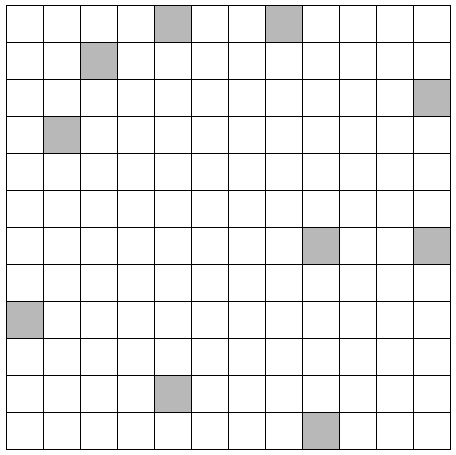
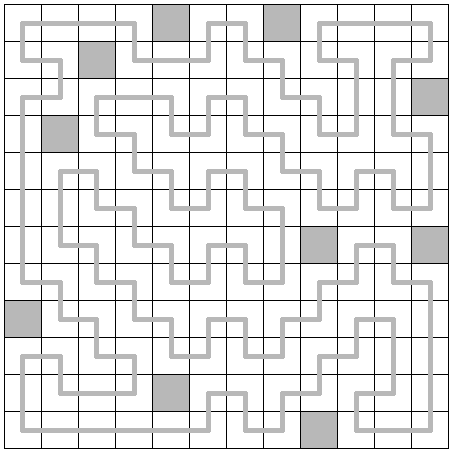
The knight’s tour is a recreation familiar to chessplayers: Move a knight about an empty chessboard so as to visit each square exactly once.
On this board, each square contains a syllable. Collect them in the right order and you’ll compose a six-line quotation from Shakespeare. What is it?
(Hint: Start on e4, “to”.)

|
SelectClick for Answer> |
The quotation is from King John, Act IV, Scene II, lines 11-16:
To gild refined gold, to paint the lily,
To throw a perfume on the violet,
To smooth the ice, or add another hue
Unto the rainbow, or with taper-light
To seek the beauteous eye of heaven to garnish,
Is wasteful and ridiculous excess.
The puzzle is taken from Miscellaneous Notes and Queries, January 1889.
|
Aug 21, 2007 | Categories: Literature, Puzzles, Quotations
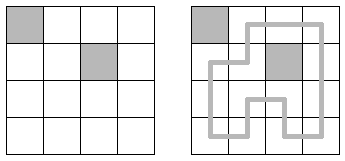
Take an ordinary chessboard and cut off two diagonally opposite corners. Now: Is it possible to tile the remaining 62 squares with 31 dominoes?
This calls for inspiration rather than trial and error. Most people see the solution immediately or not at all.
|
SelectClick for Answer> |
No, it can’t be done.
Each domino covers two squares, a light one and a dark one. Therefore a board can be tiled perfectly only if it has an equal number of light and dark squares.
The original board met this requirement, but we’ve removed two squares of the same color (diagonal corners). So the task is impossible.
|
Jul 17, 2007 | Categories: Puzzles
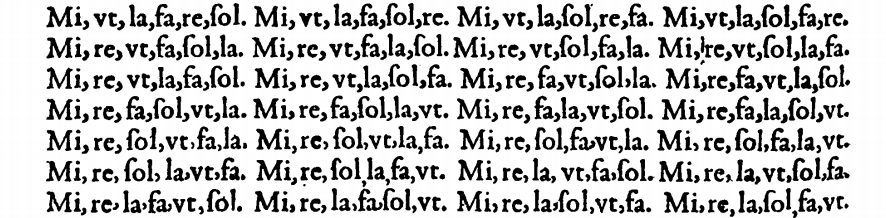
First published in 1671, this anonymous verse came with a simple instruction that would render it into sense. Can you discover it?
I saw a peacock with a fiery tail
I saw a blazing comet drop down hail
I saw a cloud with ivy circled round
I saw a sturdy oak creep on the ground
I saw a pismire swallow up a whale
I saw a raging sea brim full of ale
I saw a venice glass sixteen foot deep
I saw a well full of men’s tears that weep
I saw their eyes all in a flame of fire
I saw a house as big as the moon and higher
I saw the sun even in the midst of night
I saw the man that saw this wondrous sight.
I saw a pack of cards gnawing a bone
I saw a dog seated on Britain’s throne
I saw King George shut up within a box
I saw an orange driving a fat ox
I saw a butcher not a twelvemonth old
I saw a great-coat all of solid gold
I saw two buttons telling of their dreams
I saw my friends who wished I’d quite these themes.
|
SelectClick for Answer> |
“Read with a comma after the first noun in each line”:
I saw a peacock, with a fiery tail
I saw a blazing comet, drop down hail
I saw a cloud, with ivy circled round
I saw a sturdy oak, creep on the ground
I saw a pismire, swallow up a whale
I saw a raging sea, brim full of ale
I saw a venice glass, sixteen foot deep
I saw a well, full of men’s tears that weep
I saw their eyes, all in a flame of fire
I saw a house, as big as the moon and higher
I saw the sun, even in the midst of night
I saw the man that saw this wondrous sight.
I saw a pack of cards, gnawing a bone
I saw a dog, seated on Britain’s throne
I saw King George, shut up within a box
I saw an orange, driving a fat ox
I saw a butcher, not a twelvemonth old
I saw a great-coat, all of solid gold
I saw two buttons, telling of their dreams
I saw my friends, who wished I’d quite these themes.
|
Jul 11, 2007 | Categories: Poems, Puzzles

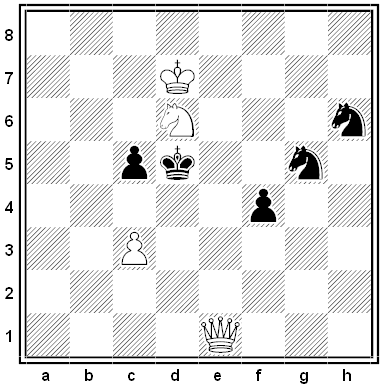
White to move. I won’t give the solution — try it out and you’ll see why.
(Composed by V. Ropke, Skakbladet, 1942.)
Jun 28, 2007 | Categories: Puzzles
Kangaroo words contain smaller versions of themselves. INDOLENT, for example, contains the letters I-D-L-E, in order. Can you find the hidden synonyms in each of these words?
- ABIDE
- ALLOCATE
- ASSEVERATE
- ASTOUND
- CALUMNIES
- CATACOMB
- DEPOSITORY
- DESTRUCTION
- ENCOURAGE
- HONORABLE
- ILLUMINATED
- INEFFECTIVE
- REVOLUTION
- SCOUNDREL
- TRANSGRESSION
- UMPTEENTH
- UNSIGHTLY
|
SelectClick for Answer> |
- ABIDE: BE
- ALLOCATE: ALLOT
- ASSEVERATE: AVER (also ASSERT)
- ASTOUND: STUN
- CALUMNIES: LIES
- CATACOMB: TOMB
- DEPOSITORY: DEPOT
- DESTRUCTION: RUIN
- ENCOURAGE: URGE
- HONORABLE: NOBLE
- ILLUMINATED: LIT
- INEFFECTIVE: EFFETE
- REVOLUTION: REVOLT
- SCOUNDREL: CUR
- TRANSGRESSION: SIN
- UMPTEENTH: NTH
- UNSIGHTLY: UGLY
|
Jun 26, 2007 | Categories: Language, Puzzles

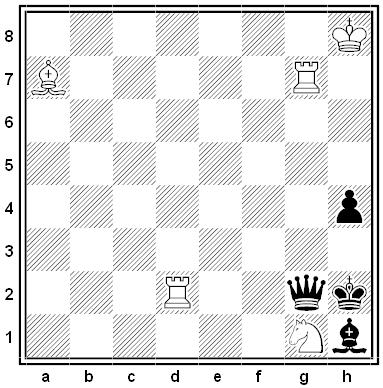
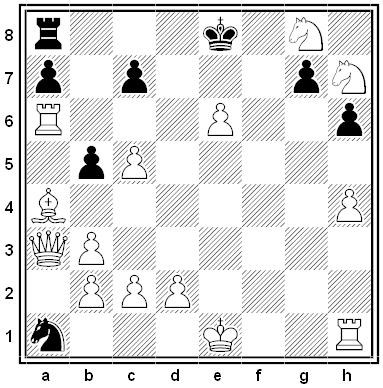
A chess puzzle set on a Mobius strip, via Lawrence Kesteloot’s puzzles page.
There are no pieces on the hidden sides, and don’t worry about the direction of the black pawn. White to move and mate in two.
|
SelectClick for Answer> |
The white queen travels clockwise until she captures the black knight next to the black king, giving check. Black’s only legal response is to capture the white knight. (The bishop can’t take the queen because it’s pinned by the rook at left.) Then the white rook at the top travels counterclockwise until it captures the black queen, giving mate.
(Thanks for Ryan for the tip, and to Lawrence for permission.)
|
Jun 16, 2007 | Categories: Puzzles
A chess problem posed by Sam Loyd, published in Le Sphinx, 1866:
“Construct a game which ends with Black delivering discovered checkmate on move four.”
Jun 6, 2007 | Categories: Puzzles

“Christopher Columbus’s Egg Puzzle,” as it appeared in Sam Loyd’s Cyclopedia of Puzzles (1914):
The famous trick-chicken, Americus Vespucius, after whom our great country was named, showed a clever puzzle wherein you are asked to lay nine eggs so as to form the greatest possible number of rows of three-in-line. King Puzzlepate has only succeeded in getting eight rows, as shown in the picture, but Tommy says a smart chicken can do better than that!
Can you?
May 31, 2007 | Categories: Puzzles

On a train, Smith, Robinson, and Jones are the fireman, the brakeman, and the engineer (not necessarily respectively). Also aboard the train are three passengers with the same names, Mr. Smith, Mr. Robinson, and Mr. Jones.
(1) Mr. Robinson is a passenger. He lives in Detroit.
(2) The brakeman lives exactly halfway between Chicago and Detroit.
(3) Mr. Jones is a passenger. He earns exactly $20,000 per year.
(4) The brakeman’s nearest neighbor, one of the passengers, earns exactly three times as much as the brakeman.
(5) Smith is not a passenger. He beats the fireman in billiards.
(6) The passenger whose name is the same as the brakeman’s lives in Chicago.
Who is the engineer?
|
SelectClick for Answer> |
We know that the brakeman doesn’t live in Detroit (2) and that his nearest neighbor is a passenger (4). So that passenger can’t be Mr. Robinson, who lives in Detroit (1).
From (3) and (4) we know that the brakeman’s nearest neighbor also can’t be Mr. Jones (because Mr. Jones earns $20,000 per year, which is not evenly divisible by 3).
Thus, if the brakeman’s nearest neighbor is not Mr. Jones and not Mr. Robinson, it must be Mr. Smith.
Now, if Mr. Robinson lives in Detroit (1) and Mr. Smith lives halfway between Chicago and Detroit (as we’ve just deduced), then the third passenger, Mr. Jones, must be the one referred to in (6) and thus lives in Chicago.
That means, also from (6), that the brakeman’s name is Jones. And if Smith is not the fireman (5), then by elimination Smith must be the engineer.
|
May 15, 2007 | Categories: Puzzles
Nothing is better than eternal happiness.
Eating a hamburger is better than nothing.
Therefore, eating a hamburger is better than eternal happiness.
Apr 18, 2007 | Categories: Language, Puzzles
“In an old church in Westchester county, N.Y., the following consonants are written beside the altar, under the Ten Commandments. What vowel is to be placed between them, to make sense and rhyme of the couplet?”
P.R.S.V.R.Y.P.R.F.C.T.M.N.
V.R.K.P.T.H.S.P.R.C.P.T.S.T.N
– Charles Bombaugh, Facts and Fancies for the Curious From the Harvest-Fields of Literature, 1860
Apr 5, 2007 | Categories: Language, Puzzles, Religion

Another puzzle from Henry Ernest Dudeney, The Canterbury Puzzles, 1908:
“Inside a rectangular room, measuring 30 feet in length and 12 feet in width and height, a spider is at a point on the middle of one of the end walls, 1 foot from the ceiling, as at A, and a fly is on the opposite wall, 1 foot from the floor in the centre, as shown at B. What is the shortest distance that the spider must crawl in order to reach the fly, which remains stationary? Of course the spider never drops or uses its web, but crawls fairly.”
|
SelectClick for Answer> |

“Though this problem was much discussed in the Daily Mail from 18th January to 7th February, 1905, when it appeared to create great public interest, it was actually first propounded by me in the Weekly Dispatch of 14th June, 1903.
“Imagine the room to be a cardboard box. Then the box may be cut in various different ways so that the cardboard may be laid flat on the table. I show four of these ways and indicate in every case the relative positions of the spider and the fly and the straightened course which the spider must take, without going off the cardboard. These are the four most favourable cases, and it will be found that the shortest route is in No. 4, for it is only 40 feet in length (add the square of 32 to the square of 24 and extract the square root). It will be seen that the spider actually passes along five of the six sides of the room! Having marked the route, fold the box up (removing the side the spider does not use), and the appearance of the shortest course is rather surprising. If the spider had taken what most persons will consider the obviously shortest route (that shown in No. 1), he would have gone 42 feet! Route No. 2 is 43.174 feet in length and route No. 3 is 40.718 feet. I will leave the reader to discover which are the shortest routes when the spider and fly are 2, 3, 4, 5, and 6 feet from the ceiling and floor respectively.”
|
Apr 2, 2007 | Categories: Puzzles
Can you make three cuts in a square of cloth and rearrange the pieces to form an equilateral triangle?
Mar 28, 2007 | Categories: Puzzles, Science & Math

The “Death’s-head Dungeon,” from Henry Dudeney’s Canterbury Puzzles (1908), in which a youth rescues a noble demoiselle from a dungeon belong to his father’s greatest enemy:
“… Sir Hugh then produced a plan of the thirty-five cells in the dungeon and asked his companions to discover the particular cell that the demoiselle occupied. He said that if you started at one of the outside cells and passed through every doorway once, and once only, you were bound to end at the cell that was sought. Can you find the cell? Unless you start at the correct outside cell it is impossible to pass through all the doorways once, and once only.”
|
SelectClick for Answer> |

“‘Some here have asked me,’ continued Sir Hugh, ‘how they may find the cell in the dungeon of the Death’s Head wherein the noble maiden was cast. Beshrew me! but ’tis easy withal when you do but know how to do it. In attempting to pass through every door once, and never more, you must take heed that every cell hath two doors or four, which be even numbers, except two cells, which have but three. Now, certes, you cannot go in and out of any place, passing through all the doors once and no more, if the number of doors be an odd number. But as there be but two such odd cells, yet may we, by beginning at the one and ending at the other, so make our journey in many ways with success. I pray you, albeit, to mark that only one of these odd cells lieth on the outside of the dungeon, so we must perforce start therefrom. Marry, then, my masters, the noble demoiselle must needs have been waiting in the other.’
“The drawing makes this quite clear to the reader. The two ‘odd cells’ are indicated by the stars, and one of the many routes that will solve the puzzle is shown by the dotted line. It is perfectly certain that you must start at the lower star and end at the upper one; therefore, the cell with the star situated over the left eye must be the one sought.”
|
Mar 20, 2007 | Categories: Puzzles
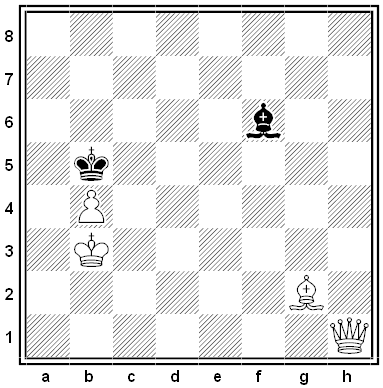
Retrograde analysis involves looking into a chess game’s past, rather than its future. Here’s an example from Henry Ernest Dudeney (1917):

“Strolling into one of the rooms of a London club, I noticed a position left by two players who had gone. This position is shown in the diagram. It is evident that White has checkmated Black. But how did he do it? That is the puzzle.”
The solution is unique. Can you find it?
|
SelectClick for Answer> |
The earlier game must have reached this position:

From here, White played e5+, and Blacked responded … f5 (the only move). Then White captured the pawn en passant, exf5 e.p., producing the final position.
|
Mar 15, 2007 | Categories: Puzzles

Here’s a valentine written by Edgar Allan Poe in 1846. His sweetheart’s name is hidden in it — can you find it?
For her these lines are penned, whose luminous eyes,
Brightly expressive as the starts of Leda,
Shall find her own sweet name that, nestling, lies
Upon the page, enwrapped from every reader.
Search narrowly these words, which hold a treasure
Divine — a talisman, an amulet
That must be worn at heart. Search well the measure –
The words — the letters themselves. Do not forget
The smallest point, or you may lose your labor.
And yet there is in this no gordian knot
Which one might not undo without a sabre
If one could merely comprehend the plot.
Upon the open page on which are peering
Such sweet eyes now, there lies, I say, perdus,
A musical name oft uttered in the hearing
Of poets, by poets — for the name is a poet’s too.
In common sequence set, the letters lying,
Compose a sound delighting all to hear –
Ah, this you’d have no trouble in descrying
Were you not something, of a dunce, my dear –
And now I leave these riddles to their Seer.
|
SelectClick for Answer> |
Poe wrote the poem for Frances Sargent Osgood:
For her these lines are penned, whose luminous eyes,
BRightly expressive as the starts of Leda,
ShAll find her own sweet name that, nestling, lies
UpoN the page, enwrapped from every reader.
SearCh narrowly these words, which hold a treasure
DivinE — a talisman, an amulet
That muSt be worn at heart. Search well the measure –
The wordS — the letters themselves. Do not forget
The smallEst point, or you may lose your labor.
And yet theRe is in this no gordian knot
Which one miGht not undo without a sabre
If one could mErely comprehend the plot.
Upon the open pAge on which are peering
Such sweet eyes Now, there lies, I say, perdus,
A musical name ofT uttered in the hearing
Of poets, by poets — fOr the name is a poet’s too.
In common sequence Set, the letters lying,
Compose a sound deliGhting all to hear –
Ah, this you’d have no trOuble in descrying
Were you not something, Of a dunce, my dear –
And now I leave these ridDles to their Seer.
(He misspelled her middle name.)
|
Mar 12, 2007 | Categories: Poems, Puzzles

You’re driving a car. The windows are closed. In the back seat is a kid holding a helium balloon.
You turn right. You and the kid sway to the left. What does the balloon do?
|
SelectClick for Answer> |
The balloon sways to the right, into the turn and away from you and the kid.
As you turn right, inertia pulls the air in the cabin to the left, displacing the balloon.
|
Mar 8, 2007 | Categories: Puzzles, Science & Math