“A Good Bargain”
A story is told of Sheridan, himself an Irishman, that one day, when coming back from shooting with an empty bag, he did not like to go home completely empty, and seeing a number of ducks in a pond, and a man or farmer leaning on a rail watching them, Sheridan said, ‘What will you take for a shot at the ducks?’
‘Well,’ he said, ‘I will take half a sovereign.’
‘Done!’ said Sheridan, and he fired into middle of the flock, killing a dozen. ‘I am afraid you made a bad bargain!’
‘I don’t know,’ said the man: ‘they weren’t mine.’
– Tit-Bits From All the Most Interesting Books, Periodicals and Newspapers in the World, Oct. 29, 1881
“The Young Man From Pall Mall”
There was a young man from Pall Mall
Who went to a fancy dress ball.
Just for the fun
He dressed up as a bun;
And was eat by a dog in the hall.
– Anonymous, in A.C. McClurg, The Humbler Poets, 1910
Next Stop
A woman proceeding by the elevated railroad, by the side of the Niagara Falls, asked the engine-driver, ‘If the rope broke, where she would go to?’ The driver told her that ‘If one broke they would have the other one to hold them.’ The woman then said, ‘Well, driver, if that broke, where should I go to?’ ‘Well,’ said the driver, ‘it just depends upon what sort of a life you have led.’
– Tit-Bits From All the Most Interesting Books, Periodicals and Newspapers in the World, Dec. 3, 1881
Rimshot
A biologist, a statistician, and a mathematician are sitting at a cafe. Across the street, a man and a woman enter a building; ten minutes later, they emerge with a child.
“They’ve reproduced,” says the biologist.
“No,” says the statistician. “It’s an observational error. On average, 2.5 people went each way.”
“You’re both wrong,” says the mathematician. “The conclusion is obvious. If someone goes in now, the building will be empty.”
Market Play

Barnum used to bring consternation into the hearts of his grocers by complaining that their pepper was half peas. When they protested, he would quietly ask, ‘How do you spell pepper?’ and the catch stood revealed.
– William Shepard Walsh, Handy-Book of Literary Curiosities, 1892
“A Satisfactory Explanation”
One of the curiosities some time since shown at a public exhibition, professed to be a skull of Oliver Cromwell. A gentleman present observed that it could not be Cromwell’s, as he had a very large head, and this was a small skull. ‘Oh, I know all that,’ said the exhibitor, undisturbed, ‘but, you see, this was his skull when he was a boy.’
– Ainsworth Rand Spofford et al., The Library of Wit and Humor, Prose and Poetry, 1894
“A Most Determined Suicide”
A gentleman passing through the United States, on the Union and Pacific Railroad, was one morning telling the guard about a relative of his lately committing suicide. ‘Very sad, indeed,’ replied the guard, ‘but the most determined attempt at suicide happened the other day down Sacramento (California) way. A young man went down to the beach when the tide was out, with a long pole, sharpened at one end, and a hook in the other; he had also a rope with a noose in it, a phial of poison, a pistol, and a box of matches. He drove the pole into the sand, and climbed up it until the tide had risen high enough to drown him, when he swallowed the poison, set his trousers on fire, put the noose round his neck, and then fired his pistol. The bullet, instead of entering his forehead, grazed the top of his head and went through the rope; the rope, being weakened, snapped, and dropped the unfortunate man into the sea, which, of course, put the fire out, and swallowing some sea water made him vomit the poison, and in two or three minutes he was washed ashore alive, and only suffering slightly from the effects of his immersion.’
– Tit-Bits From All the Most Interesting Books, Periodicals and Newspapers in the World, Dec. 3, 1881
The Pastor’s Reward
Chambers’s Journal (1872) reports the result of an unfortunate printer’s error in which two columns of type in a local newspaper were mixed together:
Several of the Rev. Dr Mudge’s friends called upon him yesterday, and after a brief conversation, the unsuspicious pig was seized by the hind-legs and slid along a beam until he reached the hot-water tank. His friends explained the object of their visit, and presented him with a very handsome gold-headed butcher, who grabbed him by the tail, swung him round, slit his throat from ear to ear, and in less than a minute, the carcass was in the water. Thereupon, he came forward, and said that there were times when the feelings overpowered one, and for that reason he would not attempt to do more than thank those around him for the manner in which such a huge animal was cut into fragments was simply astonishing. The doctor concluded his remarks, when the machine seized him, and in less time than it takes to write it, the pig was cut into fragments, and worked up into delicious sausages. The occasion will long be remembered by the doctor’s friends as one of the most delightful of their lives. The best pieces can be procured for tenpence a pound; and we are sure that those who have sat so long under his ministry will rejoice that he has been treated so handsomely!
“We cannot vouch for the genuineness of the foregoing; but whether it be genuine or manufactured, it would be difficult to find a more complete specimen of a typographical mixture.”
Dedication
There was many years ago a Lazy Man’s Society organised in Manchester. One of the articles required that no man belonging to it should ever be in a hurry. Should he violate this article he must stand treat to the other members. Now, it happened once on a time that a doctor was driving post-haste through the streets to visit a patient. The members of the society saw him and chuckled over the idea of a treat, and on his return reminded him of his fast driving and violation of the rules. ‘Not at all,’ said the doctor. ‘The truth is, my horse was determined to go, and I felt too lazy to stop him.’ They did not catch him that time.
– Tit-Bits From All the Most Interesting Books, Periodicals, and Newspapers in the World, Oct. 22, 1881
“Literal Obedience”
“Oh, slip on something and come down quick!”
His wife exclaimed with a frightened air.
He did: and he feels he has been played a trick–
For he slipped on a rug at the top of the stair.
– Bert Leston Taylor, collected in A Book of American Humorous Verse, 1917
Unsuitable Footwear
There was a young lady of Twickenham
Whose shoes were too tight to walk quick in ‘em;
She came back from her walk
Looking white as a chalk
And took ‘em both off and was sick in ‘em.
– Oliver Herford, collected in Carolyn Wells, The Book of Humorous Verse, 1920
Overheard

One bitterly cold day [Henry J.] Byron was walking along the Strand when Lionel Brough, the comedian, met him, and said, ‘Why, Byron, you never wear an overcoat.’ ‘No,’ answered the farceur, ‘no, Brough, I never was.’
– John De Morgan, In Lighter Vein, 1907
To a Thesaurus
O precious codex, volume, tome,
Book, writing, compilation, work,
Attend the while I pen a pome,
A jest, a jape, a quip, a quirk.
For I would pen, engross, indite,
Transcribe, set forth, compose, address,
Record, submit–yea, even write
An ode, an elegy to bless–
To bless, set store by, celebrate,
Approve, esteem, endow with soul,
Commend, acclaim, appreciate,
Immortalize, laud, praise, extol
Thy merit, goodness, value, worth,
Experience, utility–
O manna, honey, salt of earth,
I sing, I chant, I worship thee!
How could I manage, live, exist,
Obtain, produce, be real, prevail,
Be present in the flesh, subsist,
Have place, become, breathe or inhale
Without thy help, recruit, support,
Opitulation, furtherance,
Assistance, rescue, aid, resort,
Favour, sustention, and advance?
Alack! Alack! and well-a-day!
My case would then be dour and sad,
Likewise distressing, dismal, gray,
Pathetic, mournful, dreary, bad.
Though I could keep this up all day,
This lyric, elegiac, song,
Meseems hath come the time to say
Farewell! Adieu! Good-by! So long!
– Franklin P. Adams, collected in Carolyn Wells, The Book of Humorous Verse, 1920
This Sceptred Isle
There was a young fellow named Cholmondeley,
Who always at dinner sat dolmondeley.
His fair partner said,
As he crumbled his bread,
“Dear me! You behave very rolmondeley!”
Said a man to his spouse in east Sydenham:
“My best trousers! Now where have you hydenham?
It is perfectly true
They were not very new,
But I foolishly left half a quydenham.”
A young Englishwoman named St John
Met a red-skinned American It John
Who made her his bride
And gave her, beside,
A dress with a gaudy bead Frt John.
There was a young vicar from Salisbury
Whose manners were quite halisbury-scalisbury.
He went around Hampshire
Without any pampshire
Till his bishop compelled him to walisbury.
(Thanks, Gavin.)
A Comeuppance

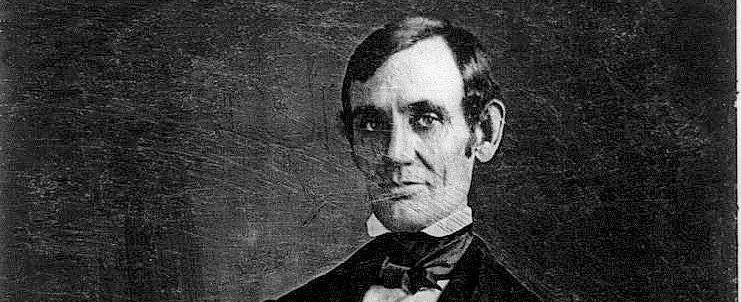
One day — said Mr. Lincoln — when I first came here, I got into a fit of musing in my room and stood resting my elbows on the bureau. Looking into the glass it struck me what an awfully ugly man I was. The fact grew on me and I made up my mind that I must be the ugliest man in the world. It so maddened me that I resolved, should I ever see an uglier, I would shoot him on sight. Not long after this, Andy — naming a lawyer present — came to town and the first time I saw him I said to myself, ‘There’s the man.’ I went home, took down my gun and prowled around the streets waiting for him. He soon came along. ‘Halt, Andy,’ said I, pointing the gun at him; ‘say your prayers, for I am going to shoot you.’ ‘Why, Mr. Lincoln, what’s the matter? What have I done?’ ‘Well, I made an oath that if I ever saw an uglier man than I am I’d shoot him on the spot. You are uglier; sure; so make ready to die.’ ‘Mr. Lincoln, do you really think that I am uglier than you?’ ‘Yes.’ ‘Well, Mr. Lincoln,’ said Andy deliberately and looking me squarely in the face, ‘if I am any uglier, fire away.’
– Harper’s Magazine, October 1877, quoted in Charles Anthony Shriner, Wit, Wisdom and Foibles of the Great, 1918
Married Life
A Frenchman, who spoke very broken English, having some Words with his Wife, endeavour’d to call her Bitch, but could not recollect the Name. At last he thought he had done it, by saying, Begar, mine Dear, but you be one vile Dog’s Wife. Aye, that’s true enough, answer’d the Woman, the more is my Misfortune.
– The Jester’s Magazine, February 1766
Loud brayed an ass. Quoth Kate, ‘My dear,
(To spouse, with scornful carriage,)
One of your relatives I hear.’
‘Yes, love,’ said he, ‘by marriage.’
– I.J. Reeve, The Wild Garland; or, Curiosities of Poetry, 1866
Lay of the Deserted Influenzaed
Doe, doe!
I shall dever see her bore!
Dever bore our feet shall rove
The beadows as of yore!
Dever bore with byrtle boughs
Her tresses shall I twide–
Dever bore her bellow voice
Bake bellody with bide!
Dever shall we lidger bore,
Abid the flow’rs at dood,
Dever shall we gaze at dight
Upon the tedtder bood!
Ho, doe, doe!
Those berry tibes have flowd,
Ad I shall dever see her bore,
By beautiful! by owd!
Ho, doe, doe!
I shall dever see her bore,
She will forget be id a bonth,
(Bost probably before)–
She will forget the byrtle boughs,
The flow’rs we plucked at dood,
Our beetigs by the tedtder stars.
Our gazigs at the bood.
Ad I shall dever see agaid
The Lily and the Rose;
The dabask cheek! the sdowy brow!
The perfect bouth ad dose!
Ho, doe, doe!
Those berry tibes have flowd –
Ad I shall dever see her bore,
By beautiful! by owd!!
– Henry Cholmondeley-Pennell, Puck on Pegasus, 1868
All Aboard!

Copenhagen was proud of its new driverless subway until commuters discovered this scene in front of the town hall in 2002.
Everything was fine — it was April Fools’ Day.
“Myopia”
As down the street he took his stroll,
He cursed, for all he is a saint.
He saw a sign atop a pole,
As down the street he took a stroll,
And climbed it up (near-sighted soul),
So he could read–and read “FRESH PAINT,” …
As down the street he took a stroll,
He cursed, for all he is a saint.
– Wallace Rice
Eire Condition
An Irishman, being ask’d if he understood French? Reply’d, Yes, Joy, I understand French perfectly well, provided it’s spoken in Irish.
– The Jester’s Magazine, February 1766
Editorializing
A marble-cutter, inscribing the words,–’Lord, she was thine’ upon a tombstone, found that he had not figured his spaces correctly and he reached the end of the stone one letter short. The epitaph therefore read:
‘Lord, she was thin.’
– Frederic William Unger, Epitaphs, 1904
Limerick
There was an old lady from Slough
Who developed a terrible cough.
She drank half a pint
Of warm honey and mint,
But, sadly, she didn’t pull through.
(Thanks, Rikki.)