Futility Closet

Three Strikes

Posted in Death, Oddities by Greg Ross on July 24th, 2009

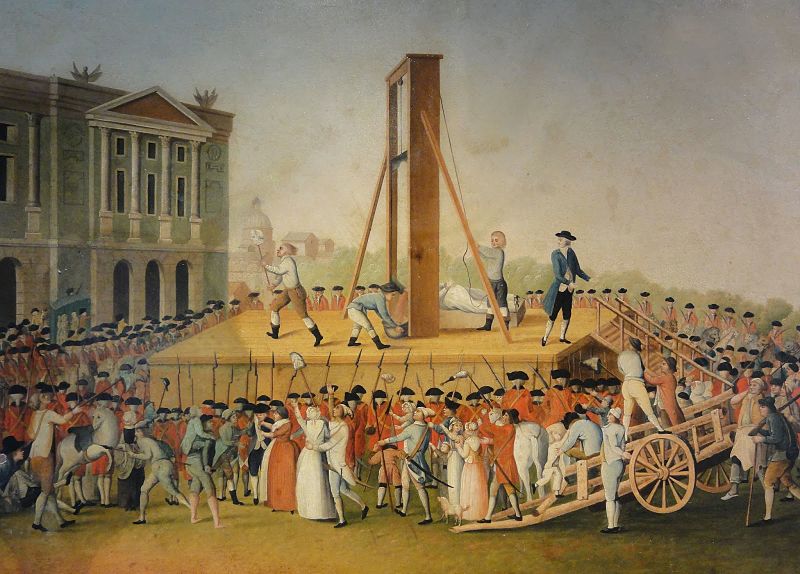
On Feb. 23, 1885, convicted murderer John Lee of Devon was brought to the scaffold and positioned on the trapdoor. The noose was fitted around his neck, and executioner James Berry pulled the lever.

Nothing happened.

Two warders tried to force the trapdoor to open under Lee, but they failed. They removed the condemned man and tested the door, and it worked. So they put Lee in position again, and again Berry pulled the lever.

Again nothing happened.

Exasperated, the warders again put Lee aside and set to work on the door, this time with hatchets. When they were satisfied, they returned him to the scaffold, and Berry pulled the lever a third time.

Nothing happened.

So the Home Secretary commuted Lee’s sentence to life imprisonment.


Editorializing

Posted in Death, Humor by Greg Ross on July 14th, 2009

A marble-cutter, inscribing the words,–’Lord, she was thine’ upon a tombstone, found that he had not figured his spaces correctly and he reached the end of the stone one letter short. The epitaph therefore read:

‘Lord, she was thin.’

– Frederic William Unger, Epitaphs, 1904


World’s Tidiest Epitaph

Posted in Death by Greg Ross on July 11th, 2009

http://books.google.com/books?id=aqZTuzkSntYC&printsec=frontcover&rview=1#PPA106,M1

Cited in Epitaphiana: or, The Curiosities of Churchyard Literature, 1873.


Exit Right

Posted in Death, Society by Greg Ross on July 4th, 2009

In the quiet graveyard near the little town of Attica lies the body of Nathaniel Grigsby and on the headstone the curious observer may read these words:

‘N. Grigsby, 2d Liu’t Co. G, 10th Indiana Volunteers. Died April 16, 1890. Age 78 years, 6 months and 5 days.’

‘Through this inscription I wish to enter my dying protest against what is called the Democratic party. I have watched it closely since the days of Jackson and know that all the misfortunes of our nation have come to it through this so-called party of treason.’

Below this inscription is added a postscript which says, ‘This inscription is placed here by the request of the deceased.’

– Thomas Allen McNeal, When Kansas Was Young, 1922


Playing Favorites

Posted in Death, Entertainment, Oddities by Greg Ross on June 14th, 2009

A tied football match in southern Congo came to an unexpected conclusion on Oct. 28, 1998, when a lightning bolt struck and killed all 11 members of the visiting team.

“The athletes from [home team] Basanga curiously came out of this catastrophe unscathed,” reported the Kinshasa newspaper L’Avenir.

“The exact nature of the lightning has divided the population in this region, which is known for its use of fetishes in football.”


R.I.P.

Posted in Death by Greg Ross on June 8th, 2009

Here lies the body of Thomas Woodhen,
The most loving of husbands and amiable of men.

N.B.—His name was Woodcock, but it wouldn’t rhyme.

Erected by his loving widow.

From Epitaphiana: or, The Curiosities of Churchyard Literature, 1873.


Cogito Ergo Zoom

Posted in Death by Greg Ross on June 7th, 2009

http://commons.wikimedia.org/wiki/File:Frans_Hals_-_Portret_van_Ren%C3%A9_Descartes.jpg

Another great man who lost his head after death: René Descartes. The French philosopher died in Sweden in 1650 and was interred there for 16 years. When his body was exhumed for return to France, the ambassador appropriated his right index finger (”the instrument of immortal writing”) and, apparently inspired, one of the Swedish guards took the skull, engraving on it “Descartes’ skull, taken and carefully kept by Israel Planstrom when the body was sent to France and hidden since that time.”

The skull bounced around Europe for 150 years, with various owners carving their names on it; it was discovered missing only when the coffin was opened again in 1819. A Swedish chemist, no doubt rolling his eyes, tracked it down and returned it to the French academy.

Bonus beheading: When Sir Walter Raleigh was executed in 1618, his head was embalmed and given to his wife. She kept it until her death in 1647, when it was returned to Raleigh’s tomb in Westminster Abbey.

For those keeping score, our list now includes Descartes, Raleigh, Joseph Haydn, Oliver Cromwell, Jeremy Bentham, and Albert Einstein. Keep ‘em coming.

(Thanks, Sarah.)


One Solution

Posted in Death, Society by Greg Ross on May 21st, 2009

Excerpt from the 1791 will of an English gentleman who had been sent unwillingly to live in Tipperary:

I give and bequeath the annual sum of ten pounds, to be paid in perpetuity out of my estate, to the following purpose. It is my will and pleasure that this sum shall be spent in the purchase of a certain quantity of the liquor vulgarly called whisky, and it shall be publicly given out that a certain number of persons, Irish only, not to exceed twenty, who may choose to assemble in the cemetery in which I shall be interred, on the anniversary of my death, shall have the same distributed to them. Further, it is my desire that each shall receive it by half-a-pint at a time till the whole is consumed, each being likewise provided with a stout oaken stick and a knife, and that they shall drink it all on the spot. Knowing what I know of the Irish character, my conviction is, that with these materials given, they will not fail to destroy each other, and when in the course of time the race comes to be exterminated, this neighbourhood at least may, perhaps, be colonized by civilized and respectable Englishmen.

From Virgil McClure Harris, Ancient, Curious and Famous Wills, 1911.


The Mummy of Birchin Bower

Posted in Death by Greg Ross on May 13th, 2009

Terrified of being buried alive, Hannah Beswick left a bequest to her family physician, Charles White, on condition that she be kept above ground for 100 years. So when she died in 1758, White added her embalmed corpse to his collection of anatomical preparations, and every day he and two witnesses raised the veil and confirmed that she was indeed dead.

But 100 years is a long time, and the observations passed from reverent to perfunctory and finally absurd. The doctor eventually stored the mummy in an old grandfather clock, whose face he would open once a year to check on the patient, and when he died Miss Beswick was actually put on display in the entrance hall of the Manchester Natural History Museum, from which, wrote Edith Sitwell, the “cold dark shadow of her mummy hung over Manchester in the middle of the eighteenth century.”

Only in 1868, 110 years after her death, did the secretary of state issue an order for Hannah’s burial, and she was interred in an unmarked grave. Perhaps by that time she was glad of the rest.

See also My Dearly Departed.


R.I.P.

Posted in Death by Greg Ross on May 11th, 2009

Conclusion of an epitaph on a tombstone in eastern Tennessee:

She lived a life of virtue, and died of cholera morbus, caused by eating green fruit, in the full hope of a blessed immortality, at the early age of twenty-one years, seven months, and sixteen days. Reader, go thou and do likewise.

From Epitaphiana: or, The Curiosities of Churchyard Literature, 1873.