STOP
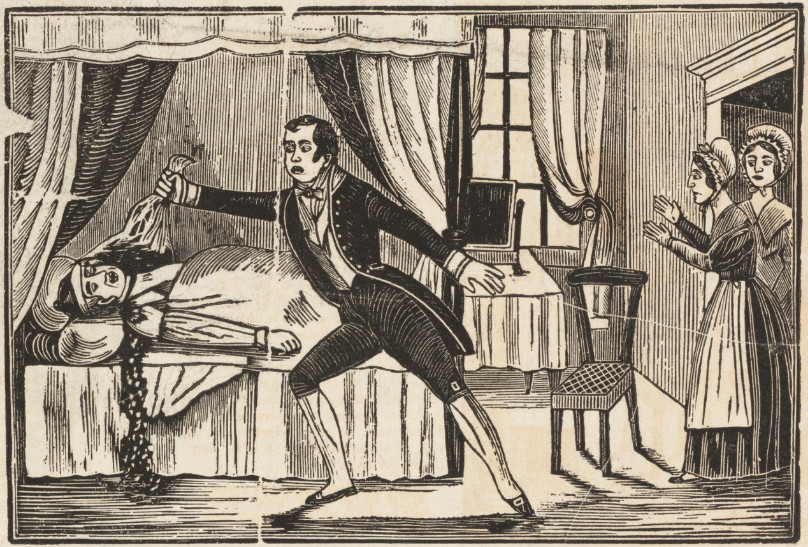
The first arrest by telegraph took place in 1845. John Tawell poisoned his mistress at her home at Salt Hill and fled by train to London, but police sent the following memorable message ahead to Paddington Station:
A MURDER HAD JUST BEEN COMMITTED AT SALT HILL AND THE SUSPECTED MURDERER WAS SEEN TO TAKE A FIRST CLASS TICKET TO LONDON BY THE TRAIN THAT LEFT SLOUGH AT 7.42 PM. HE IS IN THE GARB OF A KWAKER [the instrument lacked a Q] WITH A BROWN GREAT COAT ON WHICH REACHES HIS FEET. HE IS IN THE LAST COMPARTMENT OF THE SECOND FIRST-CLASS CARRIAGE.
In a London coffee tavern Tawell was confronted by a detective who asked, no doubt triumphantly, “Haven’t you just come from Slough?” He was jailed, tried, convicted, and hanged.
Twice Mistaken
In December 1895, Norwegian mining engineer Adolph Beck stepped out of his London flat and was accosted by a woman who accused him of tricking her out of some jewelry. Beck protested his innocence — he had been in Buenos Aires at the time — but the police accused him of an unsolved series of such swindles, and he was sentenced to seven years of penal servitude.
He was paroled in July 1901 and essentially the same thing happened again — a woman accused him of stealing her jewelry, he was arrested, and a jury found him guilty. He was saved only because another man was arrested for the same crime while Beck was awaiting sentencing. Wilhelm Meyer, it turned out, was the real swindler; Beck had been convicted twice for crimes he hadn’t committed.
They set him free and gave him £5,000, but he died a bitter man in 1909.
Unsolved
In the early morning hours of Dec. 3, 2003, assistant U.S. attorney Jonathan Luna drove north out of Baltimore. At about 1 a.m. he withdrew $200 from an ATM in Newark, Del., and at 3:20 a.m. he bought gas at a Pennsylvania service plaza. At 4:04 he exited the Pennsylvania Turnpike with a bloodstained toll ticket.
At 5:30 a.m. his car was discovered in a stream behind a Pennsylvania well drilling company. Luna’s body was under the engine. He had been stabbed 36 times with his own penknife and drowned.
Despite a federal reward of $100,000, no one has ever explained what happened that night.
“Ginger”

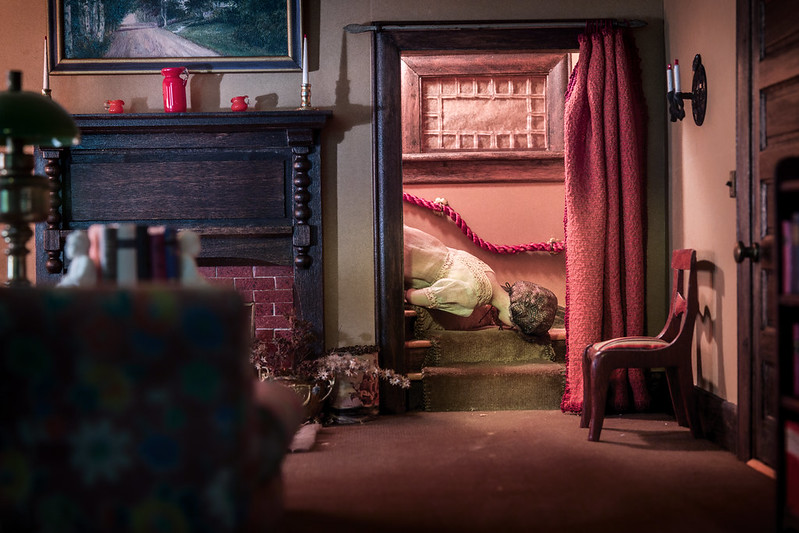
These are the remains of Mary Jane Kelly, the fifth canonical victim of Jack the Ripper. Her mutilations were far more extensive than the others’, perhaps because she was the only victim killed in a private room. From the notes of police surgeon Thomas Bond:
“The whole of the surface of the abdomen and thighs was removed and the abdominal cavity emptied of its viscera. The breasts were cut off, the arms mutilated by several jagged wounds and the face hacked beyond recognition of the features. The tissues of the neck were severed all round down to the bone.
“The viscera were found in various parts viz: the uterus and kidneys with one breast under the head, the other breast by the right foot, the liver between the feet, the intestines by the right side and the spleen by the left side of the body. The flaps removed from the abdomen and thighs were on a table.”
She was last seen alive at 2 a.m. on Nov. 9, 1888, in the company of a “Jewish-looking man” as they walked to her room. Her fellow prostitute Mary Ann Cox, unable to sleep, heard someone leave the house at 5:45. In between, at about 4 a.m., two neighbors heard a faint woman’s voice cry “Murder!”
The Shark Arm Affair

On April 25, 1935, a shark in Australia’s Coogee Aquarium disgorged a human arm. The shark had recently been caught off Sydney, but no swimmers had been reported missing. The arm, which had been severed with a knife, was eventually identified as that of 40-year-old ex-boxer James Smith, who had been missing since April 7.
Police began a murder investigation, but without a body there was no proof that Smith was dead. The case collapsed, and it remains unsolved.
Texas Dark
In 1884, America got its first serial killer. The “Servant Girl Annihilator” of Austin, Texas, would drag his victims from their beds, rape them, then kill them with an ax or a spike. In a yearlong spree he murdered at least seven women. Then he disappeared.
Three years later, Jack the Ripper surfaced in London.
See also Långrocken.
The Werewolf of Dôle
In 1572 something began killing the children of Dôle in eastern France. A 10-year-old girl was strangled and partially devoured in October; another girl succumbed after a similar attack a few weeks later, and more victims followed. The province decided there was a werewolf abroad, and one evening some workers spotted a creature carrying a child’s body through the failing light.
It wasn’t a wolf. It was Gilles Garnier, a local hermit and, as it turned out, a cannibalistic serial murderer who hunted children to feed his new wife. Garnier said that a specter had given him a magic ointment that would let him assume a wolf’s shape in order to hunt more easily.
Who’s to say he was wrong? After confessing to four murders, Garnier was convicted of “crimes of lycanthropy and witchcraft” and burned at the stake.
Work Smarter, Not Harder
On Dec. 10, 1968, a uniformed man pulled over a bank car in Tokyo. He explained that police had received a warning that dynamite had been planted in the vehicle, which was transporting bonuses for local Toshiba employees. The four passengers got out and watched as the officer crawled underneath.
After a moment he rolled out, shouting that the car was about to explode. When the passengers ran, he got in and drove off.
Thus one man stole 294,307,500 yen in broad daylight, working alone and without harming anyone. It remains the largest single heist in Japanese history. The thief was never caught.
The Alphabet Murders
In the early 1970s, an unknown assailant sexually attacked and strangled three young girls in towns near Rochester, N.Y.:
- Carmen Colon in Churchville
- Wanda Walkowicz in Webster
- Michelle Maenza in Macedon
The crimes have never been solved.
The Whitehall Mystery

Scotland Yard is built on the site of an unsolved murder.
The torso of a “well-nourished” 24-year-old woman was found in a cellar vault in October 1888, while the police service’s headquarters was being built in Westminster. Her arm had been discovered earlier on the bank of the Thames, and a reporter later discovered a leg elsewhere on the construction site.
The woman’s uterus was also missing, an unsettling echo of Jack the Ripper’s killings, which were terrorizing London at the same time. The Metropolitan Police said there was no connection.
The woman’s head and other limbs were never found, and her identity — and that of her killer — has never been established.
The “Boy in the Box”

On Feb. 25, 1957, a pedestrian came upon a cardboard box in the Fox Chase section of Philadelphia. Inside was the naked, battered body of a young boy between 4 and 6 years old.
A media sensation ensued throughout the Delaware Valley, and pictures of the boy were inserted in every gas bill in Philadelphia. But the boy’s identity has never been established, and the case has never been solved.
Murder at the Priory
In 1876, London barrister Charles Bravo took three days to die of antimony poisoning but refused to say who had poisoned him or why.
An inquest determined it was a case of willful murder, but no one was ever arrested or charged. To this day, no one knows who killed him.
Sideshow Justice

Frontier lawmen chose some odd fundraising techniques. When rangers killed Joaquin Murrieta, “the Mexican Robin Hood,” in 1853, they cut off his head, preserved it in brandy, and sent it on tour through California, charging spectators $1 per person to see it.
Captain Harry Love insisted it was the real article, but Murrieta was sighted several times after his “death,” and the pickled head was said to lack a characteristic scar.
So whose head was it? It was lost in the 1906 San Francisco earthquake, so we’ll never know.
The Gentleman Bandit

For an Old West outlaw, Black Bart had a rather poetic sensibility. Born Charles Bolles, Bart robbed stagecoaches of thousands of dollars throughout the 1870s and 1880s, but even his first victims noted his politeness — he avoided foul language and merely asked the driver to “please throw down the box.”
Eventually Bart was writing full-blown poetry to leave at the scene of each crime. He left behind this verse after one California robbery in 1877:
I’ve labored long and hard for bread,
For honor and for riches,
But on my corns too long you’ve tread
You fine-haired sons of bitches.
… and this one the following year:
Here I lay me down to sleep
To wait the coming morrow,
Perhaps success, perhaps defeat,
And everlasting sorrow.
Let come what will I’ll try it on,
My condition can’t be worse;
And if there’s money in that box
‘Tis munny in my purse.
When Bart was released from prison in 1888, a reporter asked if he were going to return to robbing stagecoaches. “No, gentlemen,” he said, “I’m through with crime.” Another asked whether he would write more poetry. He smiled, “Now, didn’t you hear me say that I am through with crime?”
Cruel and Unusual

Account of a torture and execution by elephant at Baroda, India, 1814:
“The man was a slave, and two days before had murdered his master, brother to a native chieftain, called Ameer Sahib. About eleven o’clock the elephant was brought out, with only the driver on his back, surrounded by natives with bamboos in their hands. The criminal was placed three yards behind on the ground, his legs tied by three ropes, which were fastened to a ring on the right hind leg of the animal. At every step the elephant took, it jerked him forward, and every eight or ten steps must have dislocated another limb, for they were loose and broken when the elephant had proceeded five hundred yards. The man, though covered in mud, showed every sign of life, and seemed to be in the most excruciating torments. After having been tortured in this manner for about an hour, he was taken to the outside of the town, when the elephant, which is instructed for such purposes, was backed, and put his foot on the head of the criminal.”
– From The Percy Anecdotes, 1821
Martha Tabram
In the early morning hours of Aug. 7, 1888, a London resident noticed a woman lying on a stair landing in his apartment building. He assumed she was a vagrant, and another hour passed before someone discovered she was dead — she had been stabbed 39 times in the body and neck.
Was Martha Tabram an early victim of Jack the Ripper? Like Jack’s other victims, she was a poor prostitute knifed in the early morning in a secluded but public area in Whitechapel. (Jack struck first on Aug. 31.) But Martha’s throat was not cut nor her body eviscerated, as Jack’s “canonical” victims’ were, and an autopsy suggested a weapon longer and stouter than Jack’s.
Martha’s murder was never solved. If Jack didn’t kill her — who did?
See also Långrocken.
Hinterkaifeck
One day in March 1922, German farmer Andreas Gruber told two neighbors of a curious discovery. He had found traces in the snow leading from the forest to his farm, but none leading back. He’d also found a strange newspaper. The neighbors dismissed his story, and Gruber didn’t contact the police.
Four days later, when Gruber’s granddaughter failed to appear at school, some neighbors trekked to his farm. There they found six mutilated corpses: Gruber’s entire family and a female farmhand had been murdered with a pickaxe. An autopsy showed that the 7-year-old granddaughter had been badly injured in the attack but survived for several hours. She had lain in the straw amid the bodies of her family, pulling out her hair in tufts as she died.
That’s the whole story. Police have interviewed more than 100 suspects, one as recently as 1986, but to this day no one knows who killed Andreas Gruber’s family or why.
“Bella in the Wych-Elm”

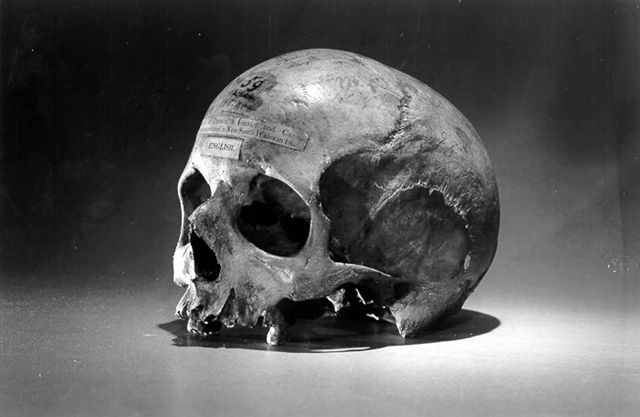
In April 1943, four young boys were exploring the woods near England’s Wychbury Hill when one climbed a large wych hazel in search of birds’ nests.
To his horror, inside the hollow trunk he found a human skull, hair and teeth. Investigation showed that the tree contained a nearly complete human skeleton, a shoe and some fragments of clothing. A human hand was found buried nearby.
The war effort prevented the English authorities from making a full investigation, but a pathologist estimated that the woman had been asphyxiated 18 months earlier and that her body was still warm when it was entombed in the tree.
But that’s as far as they got. The woman’s identity — and that of her killer — remain unknown.
(Image: Wikipedia)
The Somerton Man

On Dec. 1, 1948, a bather discovered a body on the beach near Adelaide, Australia. The man appeared to be European, about 45 years old, well dressed, and in excellent physical condition. Indeed, the coroner could not determine a cause of death. Still more strangely, it seemed the man had carried no money, and all identifying marks had been removed from his clothes. Apparently he had left a suitcase at the Adelaide railway station, but it contained no useful clues. Photos and fingerprints were circulated throughout the English-speaking world, but no one identified him.
And the body bore one last strange clue: In a trouser fob pocket, one of the investigators found a tiny piece of paper bearing the words “Taman Shud.” Those are the final words in the Rubaiyat of Omar Khayyam; they mean “The End.” A local doctor came forward with a copy of that book, from which the words had been clipped. He had found it tossed on the front seat of his car the day before the body was found.
But even that clue went nowhere. To this day, no one knows who the man was or how he died. He’s known only as the Somerton man.
Bad News for Counterfeiters

If you’ve tried to photocopy banknotes since about 1996, you may have found that your copier won’t cooperate — many machines will balk if they detect a pattern of symbols like the one on the left. Eight such patterns are marked on the U.S. $20 bill at right.
The authorities have been understandably mum about the details, but the pattern has been discovered on more than 30 world currencies. It’s known as the EURion constellation.
The Gävle Goats

There are good Swedes and bad Swedes. The good ones build a three-ton straw goat every Christmas, and the bad ones try to burn it down. This has happened almost every year since 1966, when the first goat went up in flames on New Year’s Eve. The forces of good have brought in police guards, webcams, soldiers, volunteers, and dogs, but the bad guys have usually won. In 1976 the goat was even run over by a car.
What all this means is a question for sociologists, but it’s become a local industry. In 1988 English bookmakers began laying odds on the goat’s prospects, and now “goat committees” stock up on flame retardant and extra straw. They’re up against a tough foe, though: In 40 years of struggle, only four arsonists have been caught.
“Singular Expedient”
A strange story is that related in a paper on ‘English and Irish Juries,’ in All the Year Round. The president judge in the case, Sir James Dyce, chief justice of the Court of Common Pleas, astonished at the verdict of acquittal in so plain a case, sought an interview with the foreman, who, having previously obtained a promise of secrecy during his lifetime, confessed that he had killed the man in a struggle in self-defence, and said that he had caused himself to be placed on the jury in order to insure his acquittal.
– Charles Bombaugh, Facts and Fancies for the Curious From the Harvest-Fields of Literature, 1905
Smile

In 1911, Argentine con man Eduardo de Valfierno found a way to steal the Mona Lisa six times over at no risk to himself.
First he made private deals with six separate buyers to steal and deliver the priceless painting. Then he hired a professional art restorer to make six fakes, and shipped them in advance to the buyers’ locales (to avoid later trouble with customs).
In August he paid a thief to steal the original from the Louvre, and when news of the theft had spread he delivered the six fakes to their recipients, exacting a high price for each. Then he quietly disappeared. The flummoxed thief was soon caught trying to sell the red-hot original, and it was returned to the museum in 1913.
Table for One
Last meals:
- Ted Bundy: Steak (medium rare), eggs over easy, hash browns, coffee. (He refused it.)
- John Wayne Gacy: Fried chicken, fried shrimp, french fries, fresh strawberries.
- Gary Gilmore: Hamburger, eggs, a baked potato, coffee, three shots of whiskey.
- Timothy McVeigh: Two pints of Ben & Jerry’s mint chocolate-chip ice cream.
- Adolf Eichmann: Half a bottle of Carmel, a dry red Israeli wine.
- Bruno Hauptmann: Celery, olives, chicken, french fries, buttered peas, cherries, and a slice of cake.
Victor Feguer, executed in 1963 for shooting a doctor, asked for a single olive.