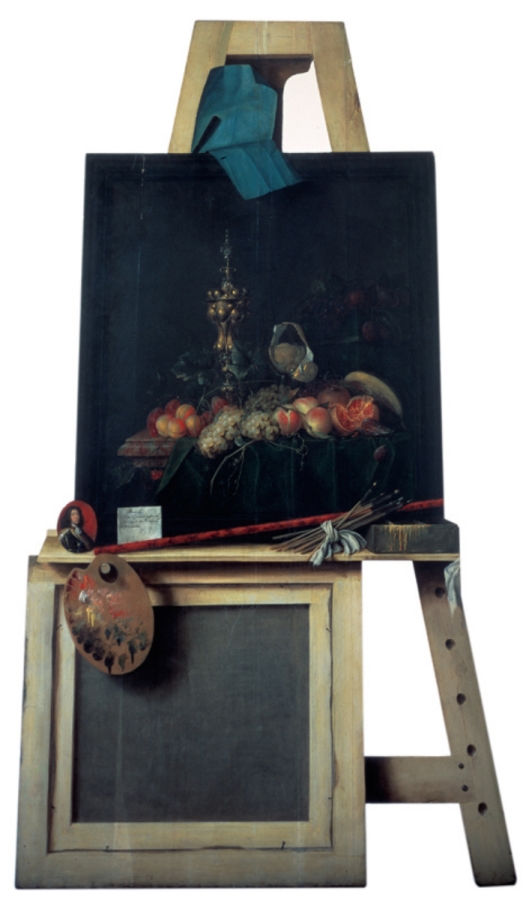
The 1672 painting Easel With Still Life of Fruit, by the Flemish painter Cornelius Gijsbrechts, is a sort of apotheosis of trompe-l’œil: The whole thing — not just the still life itself but the easel, all the tools, the other pictures, and the letter — have been painted on a wooden cutout; it’s all an illusion.
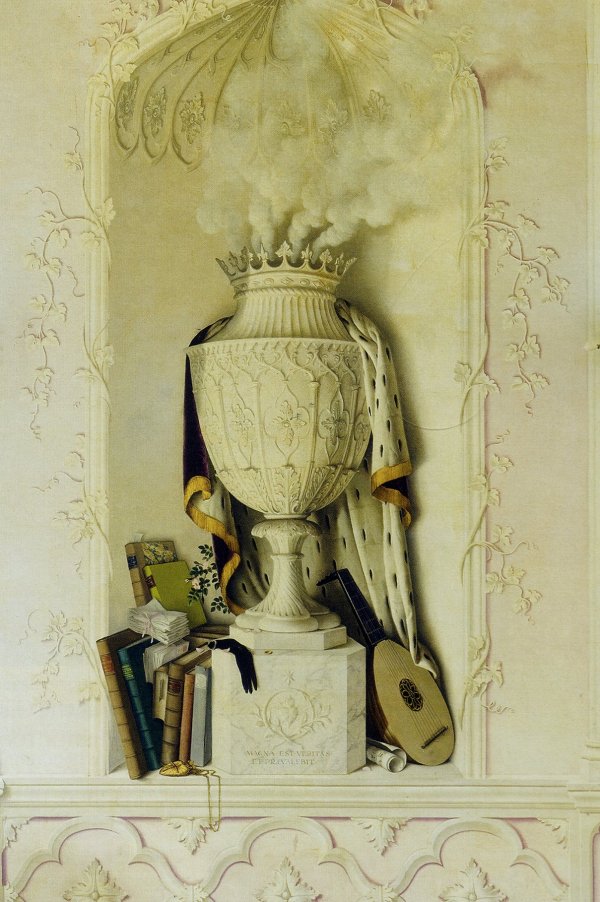
Another striking example of trompe-l’oeil, this one painted by RexWhistler at Mottisfont Abbey in Hampshire, England: The niche, the brazier, and all the objects are painted in place on a wall in the drawing room. Click to enlarge.
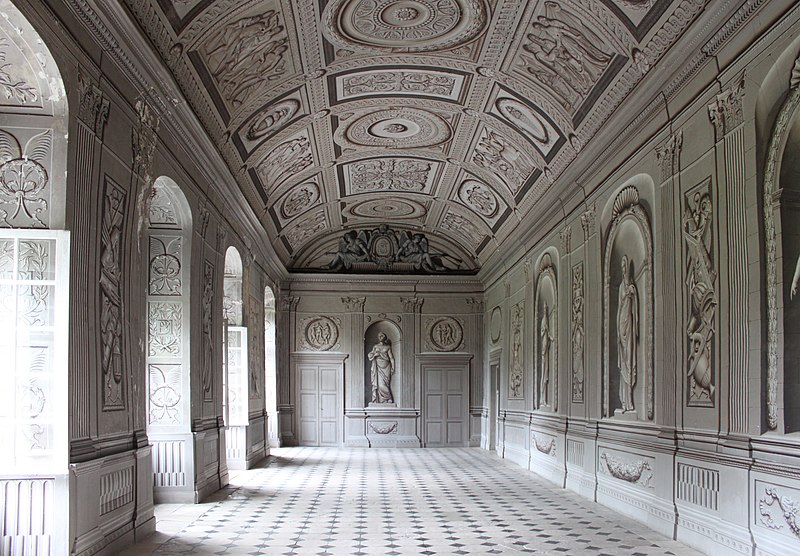
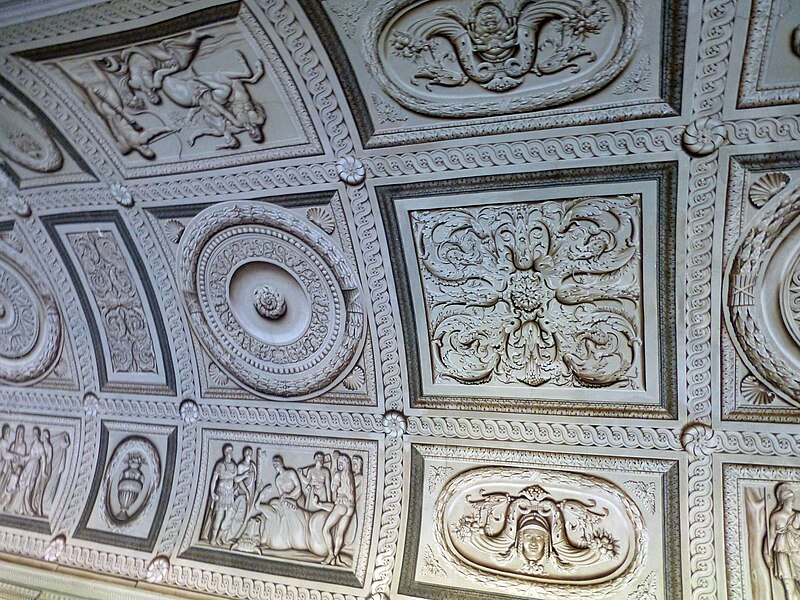
The grand gallery on the first floor of the Château de Tanlay, in Burgundy, appears to bear a vast program of sculptural decorations, but it’s all an illusion — the images were painted onto the walls and vaulted ceiling by Italian artists using the monochromatic technique known as grisaille.
The room, 26 meters long, was originally longer still, having been damaged in a fire in 1761.
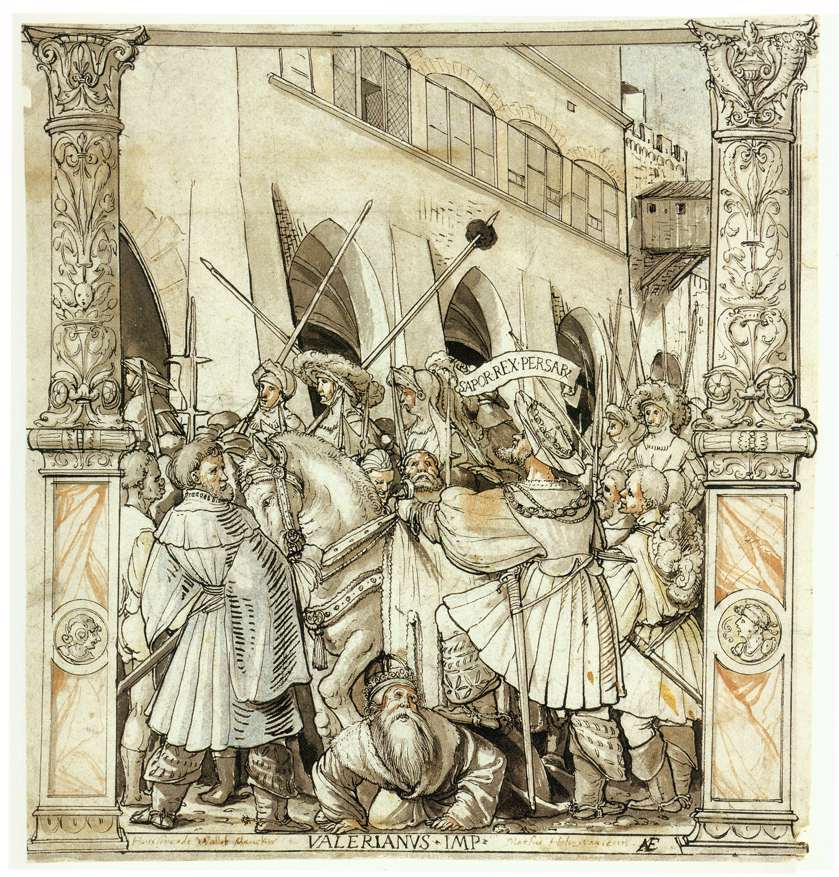
Captured at the Battle of Edessa, the Roman emperor Valerian spent the rest of his life as a footstool, used by the Sassanian emperor Shapur I to mount his horse.
The story may be only propaganda, but it inspired Hans Holbein the Younger to compose this sketch in 1521.
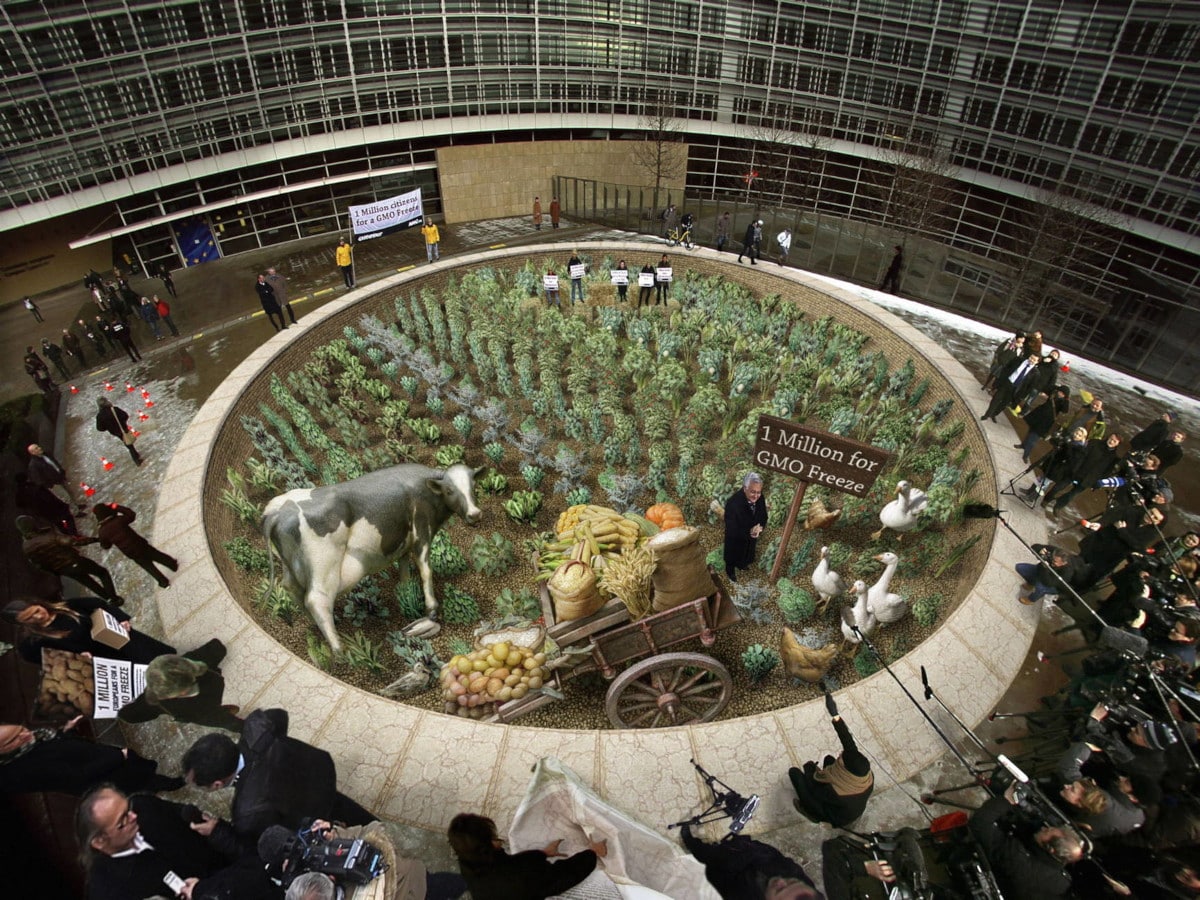
Ex-JPL conceptual artist Kurt Wenner created this anamorphic drawing in 2010 for Greenpeace, to commemorate a million-signature petition opposing genetically modified crops in Europe.
Seen from this angle the illusion is so compelling that it’s hard to tell what’s what. Within the circle Wenner (addressing reporters) is real, as are the five people behind him bearing signs, and the bales immediately surrounding them. But I believe everything else within the ring is drawn. For comparison here’s an image by Pyramid Visuals, which produced the substrate on which the image was printed.
At 22 meters square, the image set a world record at the time as the largest of its kind drawn by a single person.
Simon Beck creates large-scale artworks by walking through fields of snow. Working primarily in the Alps, he creates about 30 drawings each winter, shuffling through pristine snowfalls guided by a compass. A single image can require 10 hours’ time and 30 miles of of walking.
“Making these drawings is map-making in reverse,” he told the Guardian. “You start with the map, and you need to make the ground agree with the map.”



.jpg)

