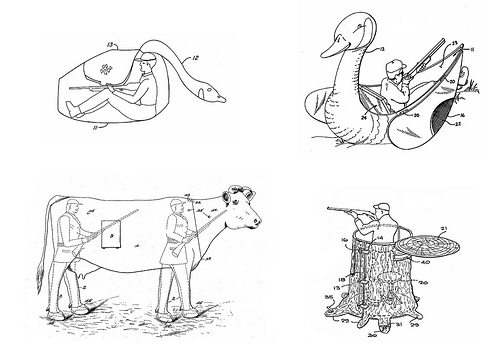
Hunting blinds, 1897-1991. Are these the ingredients of the perfect crime? You could dress up as a cow and shoot your rich Uncle Oswald, then stand there and chew your cud as the police searched for clues.
Perhaps someone’s already done this.

Hunting blinds, 1897-1991. Are these the ingredients of the perfect crime? You could dress up as a cow and shoot your rich Uncle Oswald, then stand there and chew your cud as the police searched for clues.
Perhaps someone’s already done this.
Down in the silent hallway
Scampers the dog about,
And whines, and barks, and scratches,
In order to get out.
Once in the glittering starlight,
He straightway doth begin
To set up a doleful howling
In order to get in.
— R.K. Munkittrick, in A Book of American Humorous Verse, ed. Carolyn Wells, 1917
In 1938, a group of freshmen at the University of Michigan circulated a petition asking that a psychology lecture be rescheduled to avoid a conflict with a football game. The upperclassmen who signed it read the full text in the undergraduate newspaper the following day:
We, the undersigned, hereby petition that the lecture in Psychology 2 be changed from Saturday to Wednesday afternoon. By signing this document without reading it we cheerfully disqualify ourselves as candidates for any degree conferred by this university. We furthermore declare that the freshmen are our superiors in wit and wisdom, and that our stupidity is surpassed only by the mental lethargy of the underpaid faculty that teaches us.
I can’t find a report of the fallout, but there sure must have been some. “Carelessness,” wrote Benjamin Franklin, “does more harm than a want of knowledge.”
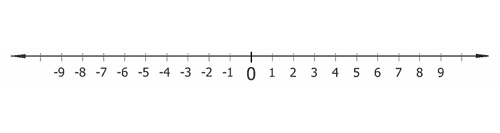
In English, the name of each integer shares a letter with each of its neighbors. ONE shares an O with TWO, TWO shares a T with THREE … and so on to infinity.
coenaculous
adj. loving supper
Crouching in a Flanders trench in November 1917, 21-year-old Walter Butler addressed a field service card to his fiancee Amy to let her know he was safe.
She never received it. After the war Butler returned to England and the pair married, moved to London, and had a daughter. Eventually they divorced; Amy returned to her family home while Walter remarried and led a career as a builder. She died in 1974 at age 81, he four years later at 82.
In February 2007, the card arrived. Their daughter, now an 86-year-old grandmother, received it.
“I am quite well,” it said. “Letter follows at first opportunity. I have received no letter from you for a long time.”

The South African flower Mesembryanthemum draws its name from the Greek roots for middle, embryo, and flower.
It’s believed to be the English word containing the highest “score” in Roman numerals — four Ms.
01/19/2025 UPDATE: The Scrabble word list CSW24 includes 10 words with four Ms: MAMMECTOMIES, MAMMECTOMY, MAMMIFORM, MAMMILLIFORM, MAMMOGRAM, MAMMOGRAMS, MAMMONISM, MAMMONISMS, MUMMIFORM, and MUMMIFORMS. Of these, the highest Roman numeral scores would be MAMMILLIFORM (4102), MAMMECTOMIES (4101), and MAMMECTOMY (4100). Too long for Scrabble, the 17-letter IMMUNOCOMPROMISED also has four Ms and tallies to 4602. (Thanks, Michael.)
Excavating a cave near the sacred Galilean catacomb of Beth She’Arim in 1956, a bulldozer unearthed an enormous rectangular slab, 11 × 6.5 × 1.5 feet. Rather than try to move the 9-ton mass, workers at first paved over it. Seven years would pass before anyone thought to examine it closely.
It was one gigantic piece of glass.
No one knows who made it or precisely how. Evidently an ancient furnace had produced great batches of molten glass that could be cooled and broken into reworkable pieces. This batch had been abandoned, perhaps because contamination had ruined its clarity.
Whatever its origins, it’s an amazing achievement. On its discovery, the Beth She’Arim slab was the third largest piece of glass ever made; even today, only large telescope mirrors rival its size. And it was produced 1600 years ago.
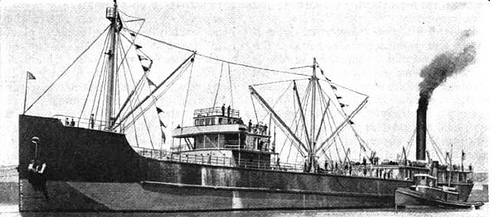
The New York Times carried a surprising headline on March 15, 1918: BIG CONCRETE SHIP AFLOAT IN PACIFIC. Noting the lack of shipyards and steel plants on the West Coast, California businessman W. Leslie Comyn had built a 7,900-ton steamer out of ferrocement.
“The huge hull, careening sharply as it slid sidewise down a steeply pitched incline, threw up a big wave in the narrow estuary, but then righted sharply and rode like a buoy,” the Times reported. “She looks as if she might have been carved out of rock, so massive is her build.”
Experts announced a new era of rapid shipbuilding, and Comyn made plans to build 54 more concrete vessels. But steel ships, though more expensive, proved lighter and faster, and by 1921 Faith had been sold and scrapped as a breakwater in Cuba.
There lived an old man in the Kingdom of Tess,
Who invented a purely original dress;
And when it was perfectly made and complete,
He opened the door and walked into the street.
By way of a hat he’d a loaf of Brown Bread,
In the middle of which he inserted his head;
His Shirt was made up of no end of dead Mice,
The warmth of whose skins was quite fluffy and nice;
His Drawers were of Rabbit-skins, so were his Shoes;
His Stockings were skins, but it is not known whose;
His Waistcoat and Trowsers were made of Pork Chops;
His Buttons were Jujubes and Chocolate Drops;
His Coat was all Pancakes, with Jam for a border,
And a girdle of Biscuits to keep it in order.
And he wore over all, as a screen from bad weather,
A Cloak of green Cabbage-leaves stitched all together.
He had walked a short way, when he heard a great noise
Of all sorts of Beasticles, Birdlings, and Boys;
And from every long street and dark lane in the town
Beasts, Birdles, and Boys in a tumult rushed down.
Two Cows and a Calf ate his Cabbage-leaf Cloak;
Four Apes seized his Girdle, which vanished like smoke;
Three Kids ate up half of his Pancaky Coat,
And the tails were devoured by an ancient He-Goat;
An army of Dogs in a twinkling tore up his
Pork Waistcoat and Trowsers to give to their Puppies;
And while they were growling and mumbling the Chops,
Ten Boys prigged the Jujubes and Chocolate Drops.
He tried to run back to his house, but in vain,
For scores of fat Pigs came again and again;
They rushed out of stables and hovels and doors;
They tore off his Stockings, his Shoes, and his Drawers.
And now from the housetops with screechings descend
Striped, spotted, white, black, and grey Cats without end;
They jumped on his shoulders and knocked off his hat,
When Crows, Ducks, and Hens made a mincemeat of that:
They speedily flew at his sleeves in a trice
And utterly tore up his Shirt of dead Mice;
They swallowed the last of his Shirt with a squall,–
Whereon he ran home with no clothes on at all.
And he said to himself as he bolted the door,
“I will not wear a similar dress any more,
“Any more, any more, any more, nevermore!”
— Edward Lear