“A Snow Mushroom”

Posted in Oddities by Greg Ross on September 5th, 2009

"http://books.google.com/books?id=ozETAAAAYAAJ&pg=PA98&dq=%22snow+mushroom%22&as_brr=3&ei=0CVWSqykK4PCMq7Q0aMH#v=onepage&q=%22snow%20mushroom%22&f=false

From the American Annual of Photography, 1908:

It is a natural snow-cap resting on the stump of a felled tree. The cap is nine feet in diameter and nearly four feet thick. Its weight has caused the rim to bend so that the top becomes a curved dome. The originally horizontal strata of the snow slope steeply downwards near the rim and small pieces break off where the strength is least, hence the edges are rough though the top is smooth. The cap acts as an umbrella sheltering the ground beneath from snowfall. The structure had taken some months to grow and would have been difficult to dislodge, for the snow was firmly welded by its own pressure. The total weight of the snow cap was calculated at about one ton.

See also Mushroom Rocks.


Find the Theme, Part 1

Posted in Puzzles by Greg Ross on September 4th, 2009

What do these words have in common?

  • BEANED
  • DOTTED
  • GRANTED
  • HERBAL
  • HOMERED
  • JACKAL
  • LEEWARD
  • ROYAL
  • PATRON
  • VICTIM
  • VICTORIAN

Click for answer …


The Jumping Frenchmen of Maine

Posted in Oddities by Greg Ross on September 4th, 2009

In 1878, neurologist George Miller Beard noted a strange trait among the French-Canadian lumberjacks in the Moosehead Lake area of Maine — they reacted strongly when startled:

  • “One of the jumpers while sitting in his chair with a knife in his hand was told to throw it, and he threw it quickly, so that it stuck in a beam opposite; at the same time he repeated the order to throw it, with cry or utterance of alarm resembling that of hysteria or epilepsy.”
  • “He also threw away his pipe when filling it with tobacco when he was slapped upon the shoulder.”
  • “Two jumpers standing near each other were told to strike, and they struck each other very forcibly.”
  • “One jumper when standing by a window, was suddenly commanded by a person on the other side of the window, to jump, and he jumped straight up half a foot from the floor, repeating the order.”
  • “One of these jumpers came very near cutting his ‘throat’ while shaving on hearing a door slam.”
  • “They had been known to strike their fists against a red-hot stove; they had been known to jump into the fire and into water; they could not help striking their best friend, if near them, when ordered.”
  • “It was dangerous to startle them in any way when they had an axe or knife in their hand.”

The condition, whatever it was, ran in families, chiefly among men, and the jumpers were otherwise “modest, quiet, retiring, deficient in power of self-assertion and push.” Similar cases have since been observed in Malaysia and Siberia, but no one knows whether the disorder is ultimately neurological or psychological.


In a Word

Posted in Language by Greg Ross on September 3rd, 2009

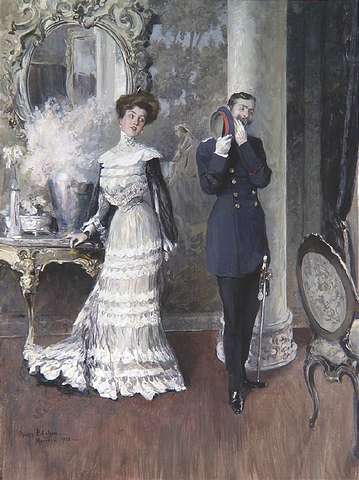
http://commons.wikimedia.org/wiki/File:Oscar_Bluhm_Erm%C3%BCdende_Konversation.jpg

oscitant
adj. drowsy or inattentive


Air Travel

Posted in Oddities by Greg Ross on September 3rd, 2009

Remarkable outcome of a London séance, June 3, 1871, as reported in The Spiritual Magazine, July 1:

After a considerable time an object was felt to come upon the table, and when the light was struck their visitor was found to be Mrs. [Agnes] Guppy. She was not by any means dressed for an excursion, as she was without shoes, and had a memorandum book in one hand and a pen in the other. The last word inscribed in the book was ‘onions,’ the ink of which was wet, and there was ink in the pen. When Mrs. Guppy regained her consciousness, she stated that she had been making some entries of expenses, became insensible, and knew nothing till she found herself in the circle.

In his Miscellanies Upon Various Subjects (1696), antiquarian John Aubrey writes that a gentleman of his acquaintance, “Mr. M.,” was burned by the inquisition in Portugal in 1655 “for being brought thither from Goa, in East-India, in the air, in an incredible short time.”


Excelsior!

Posted in Literature by Greg Ross on September 2nd, 2009

In 1917, when a young T.S. Eliot was working at Lloyds Bank in London, one of his superiors met the critic I.A. Richards on holiday in Switzerland.

The banker was relieved to hear that Richards thought Eliot a good poet. Some of his colleagues had feared that poetry was a poor grounding for a career in finance, but if the young man really enjoyed his hobby then perhaps it could help him in his work.

In fact, the banker said, “I don’t see why — in time, of course, in time — he mightn’t even become a branch manager.”


Rough Indeed

Posted in Entertainment by Greg Ross on September 2nd, 2009

http://en.wikipedia.org/wiki/File:Golf_Course_Camp_Bonifas.jpg

The world’s most dangerous golf hole is at Camp Bonifas in South Korea. It’s just south of the demilitarized zone, it’s a par 3, and it’s surrounded on three sides by live minefields.

I’ll wait over here.


Sum Caws

Posted in Language,Science & Math by Greg Ross on September 1st, 2009

The Russian for crow (a bird) in the genitive case plural is sorok. The same word also means forty. Hence, the ambiguous construction ’100 crows + 100 crows = 200 crows’ can also mean ’140 + 140 = 280.’

– V.M. Bradis, Lapses in Mathematical Reasoning, 1938


The Paradox of Future Individuals

Posted in Oddities,Society by Greg Ross on September 1st, 2009

Any large-scale change in human behavior will literally change the human race: Because such a change alters the conditions under which individuals are conceived, our grandchildren in one scenario will be different people from those in another. This is particularly true in sweeping policy matters such as the environment, global warming, etc.

This seems to suggest that we needn’t feel guilty about our poor stewardship. The descendants who would benefit by our reform are different from those who will suffer at our neglect–and we owe a duty only to the latter.


Page 7 of 7« First...34567